
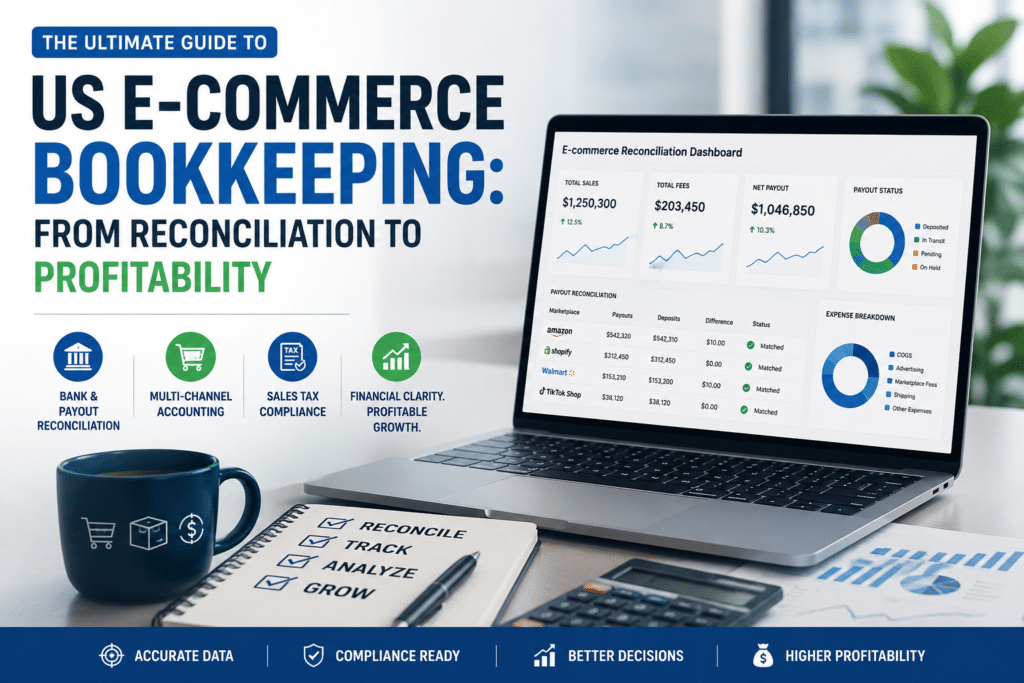
Modern retail necessitates a profound understanding of how platform data interacts with your general ledger. By mastering these complex principles, we can assist in transforming your operations from simple revenue-driven models into truly sustainable, profit-driven businesses. Our objective is to bridge the gap between raw sales data and actionable financial intelligence.Navigating the financial landscape of the digital market is challenging, yet it is vital for long-term success. Adherence to professional E-commerce bookkeeping USA standards ensures that every transaction is accounted for accurately. We aim to guide you through the essential steps to secure your company’s financial future.
Key Takeaways
- Poor cash flow management is a leading cause of business failure in the retail sector.
- Specialized financial tracking is critical for modern online sellers to remain competitive.
- Integrating platform data with your general ledger improves overall financial accuracy.
- Shifting from revenue-focused to profit-focused models ensures long-term business sustainability.
- Professional accounting standards provide the clarity needed to make informed growth decisions.
Understanding E-commerce Bookkeeping USA Essentials
Online sellers often overlook the financial nuances of their digital storefronts, much like traditional retail shops. Online seller accounting necessitates a specialized framework, tailored to the unique dynamics of digital commerce. Without it, the true profitability of your business can remain obscured amidst a sea of automated transactions.
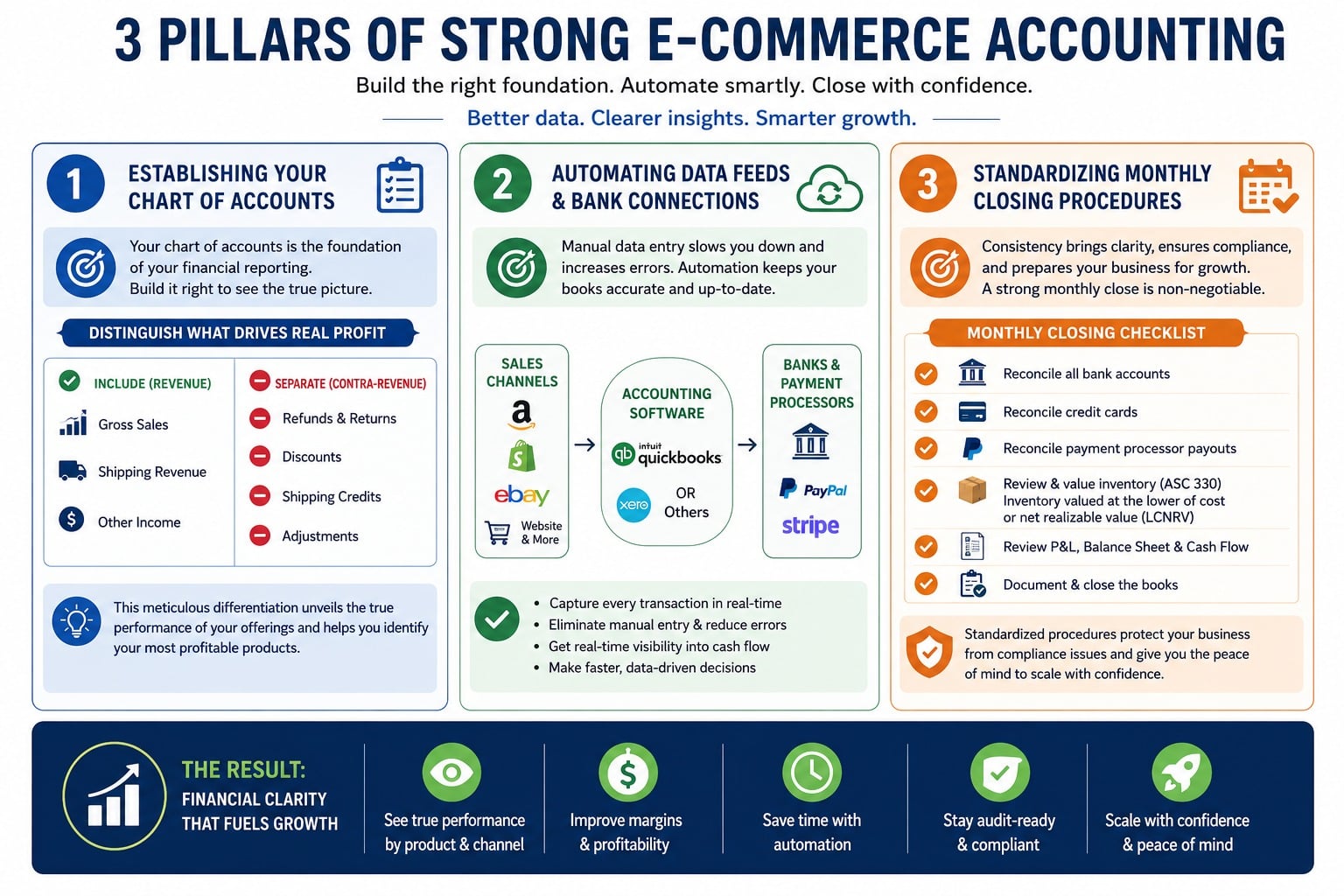
Infographic explaining the three pillars of ecommerce accounting including chart of accounts automation and monthly reconciliation procedures.
Defining the E-commerce Accounting Difference
E-commerce bookkeeping entails the systematic recording and organization of financial data across various digital sales channels. Unlike traditional retail, your business faces complex variables such as platform commissions, FBA storage fees, and real-time customer refunds. These costs often materialize before the cash reaches your bank account.
Given the digital nature of these transactions, precise tracking is imperative. Your role extends beyond mere sales recording; it encompasses the management of a complex web of financial events. This level of detail is critical in distinguishing a thriving brand from one struggling to scale.
Why Traditional Accounting Methods Fall Short for Online Sellers
Traditional accounting methods often falter due to their reliance on simple cash-basis reporting. They fail to account for the intricacies of marketplace payouts and the delay between sale and deposit. Outdated systems lead to the omission of hidden costs, which erode your margins.
Many sellers observe healthy gross margins on paper but face a stark reality when checking their bank balance. This discrepancy is often due to unrecorded platform fees and inventory adjustments. Online seller accounting ensures that every penny is accounted for in real-time, bridging this gap.
| Feature | Traditional Retail | E-commerce Model |
|---|---|---|
| Transaction Speed | Immediate | Delayed (Payout cycles) |
| Fee Structure | Fixed/Simple | Complex (FBA, Referral, Ad) |
| Sales Tax | Point of Sale | Multi-state Nexus |
| Refunds | Manual/Rare | Automated/Frequent |
The Financial Impact of Proper Bookkeeping on Your Bottom Line
Accurate cost classification is essential for a healthy bottom line. Correctly categorizing expenses provides the clarity needed for strategic decision-making. This is the core benefit of online seller accounting in today’s market.
Proper financial management safeguards your profits by revealing which products are truly successful. It helps identify hidden losses early, preventing them from becoming systemic issues. Mastering these essentials positions your business for sustainable growth and long-term success.
Navigating the Three Pillars of E-commerce Financial Challenges
Our experience reveals that robust financial management is contingent upon resolving three critical operational puzzles. As your business scales, these hurdles often emerge as primary barriers to sustained growth. Addressing these areas can significantly enhance your E-commerce financial management and safeguard your profit margins.
Mastering Reconciliation Gaps in High-Volume Sales
High-volume sales introduce significant timing discrepancies between order placement and cash receipt. These discrepancies can obscure your true cash flow if not addressed through rigorous reconciliation during each settlement cycle.
It is advisable to reconcile accounts at least once per payout period. This practice ensures the reliability of your financial statements and allows for the detection of discrepancies before they escalate into larger issues.
Ecommerce reconciliation is the process of matching marketplace payouts, bank deposits, platform fees, refunds, and inventory movements to ensure financial accuracy across all sales channels. Proper reconciliation helps online sellers identify hidden discrepancies, protect profit margins, and maintain reliable financial reporting.
Simplifying US Sales Tax Compliance Across State Lines
Navigating the complex US sales tax landscape poses a significant challenge for any expanding retailer. The advent of economic nexus laws has made it obligatory to collect and remit tax in multiple states, contingent upon sales volume or transaction count.
Non-compliance can incur severe penalties and interest charges. To maintain compliance, consider the following essential steps for tax management:
- Monitor your sales thresholds in every state where you have customers.
- Automate tax collection at the point of sale to ensure accuracy.
- Review your nexus status quarterly to account for rapid growth.
Solving the Multi-Channel Integration Puzzle
Selling across platforms like Amazon, Shopify, and TikTok Shop creates a fragmented data environment. Effective multi-channel bookkeeping necessitates a centralized system that aggregates data from all sources into a unified view.
Without such integration, you risk double-counting revenue or missing critical expense data. The following table highlights the common challenges of managing multiple sales channels:
| Challenge | Impact on Business | Recommended Action |
|---|---|---|
| Data Silos | Inaccurate reporting | Use cloud-based sync tools |
| Payout Delays | Cash flow strain | Standardize settlement tracking |
| Inventory Sync | Overselling risks | Implement real-time inventory software |
By mastering these three pillars, you transform your back-office operations from a source of stress into a competitive advantage. Consistent E-commerce financial management empowers you to make data-driven decisions, driving your long-term success.
Selecting the Right Accounting Infrastructure
Establishing a solid financial base necessitates the selection of appropriate software for your enterprise. As your business expands, multi-channel bookkeeping emerges as a critical component of operational success. Without a unified system, managing revenue and expenses across different platforms becomes a daunting task.
Comparing Top Platforms: QuickBooks Online, Xero, and Wave
The choice of the ideal platform hinges on your business’s size and complexity.
QuickBooks Online
stands out as the industry benchmark, boasting deep integration capabilities and advanced reporting features. It excels for businesses requiring sophisticated inventory management and detailed tax preparation.
Xero
is celebrated for its user-friendly interface, appealing to growing businesses. Its extensive app ecosystem simplifies complex workflows. In contrast,
Wave
is favored by smaller startups or solo entrepreneurs seeking a cost-effective, streamlined accounting solution.
| Platform | Best For | Key Strength | Scalability |
|---|---|---|---|
| QuickBooks Online | Growing Brands | Advanced Reporting | High |
| Xero | Tech-Savvy Sellers | App Ecosystem | High |
| Wave | Small Startups | Ease of Use | Low to Medium |
Marketplace-Specific Considerations for Amazon FBA and Shopify
Selling on Amazon requires accounting for referral commissions, FBA charges, and storage fees deducted before settlement. Accurate mapping of these deductions is critical to ensure your multi-channel bookkeeping accurately reflects net profit, not just gross sales.
Shopify users benefit from direct integrations that automatically sync sales data. Yet, reconciling these payouts against bank deposits is necessary to account for payment gateway fees. Consistency in data mapping is key to avoiding discrepancies between marketplace reports and bank statements.
For a detailed breakdown of managing these platforms, see our comprehensive
Ecommerce Bookkeeping USA Guide for Shopify & Amazon Sellers
.
Managing Inventory and Payouts for TikTok Shop and Walmart
Platforms like TikTok Shop and Walmart introduce unique financial tracking challenges. Their distinct payout schedules and fee structures differ from established marketplaces. An infrastructure capable of handling these varied data feeds without manual intervention is essential.
Effective multi-channel bookkeeping mandates treating each marketplace as a unique revenue stream while consolidating data into a single source of truth. Automating these connections minimizes the risk of human error, providing a clearer inventory turnover picture. Such visibility is critical for maintaining healthy cash flow as you expand across the digital realm.
Step-by-Step Implementation Roadmap for Online Sellers
Initiating a robust financial framework for your enterprise necessitates a deliberate approach. By delineating a structured pathway, you can metamorphose disorganized data into lucid, actionable insights, catalyzing growth.
Establishing Your Chart of Accounts
Your chart of accounts constitutes the foundational element of your financial reporting. It is advisable to craft a bespoke structure, distinguishing gross sales from contra-revenue items such as refunds, discounts, and shipping credits.
This meticulous differentiation unveils the true performance of your offerings. Without such distinction, profit margins are shrouded in ambiguity, hindering the identification of successful products.
Automating Data Feeds and Bank Connections
Manual data entry hampers both efficiency and precision. By integrating your sales platforms with your accounting software, your online seller accounting remains up-to-date, obviating the necessity for incessant manual updates.
Automation facilitates the capture of every transaction in real-time. This minimizes the likelihood of human error, affording a real-time perspective on cash flow, critical for expeditious, informed business decisions.
Standardizing Monthly Closing Procedures
Consistency is imperative for audit preparedness and financial clarity. We advocate for the adoption of a standardized monthly checklist, ensuring the reconciliation of all bank accounts, credit cards, and payment processor payouts.
During this phase, inventory valuation must adhere to ASC 330, valuing inventory at the lower of cost or net realizable value (LCNRV) to ensure accurate financial reporting.
Standardizing these procedures fosters a dependable cadence for your online seller accounting. Such discipline not only safeguards your enterprise from compliance breaches but also fosters the tranquility required for operational expansion.
Scaling Your Business with Virtual CFO Services and Avoiding Common Pitfalls
Scaling your business necessitates a sophisticated approach to E-commerce financial management, transcending basic record-keeping. As your operations expand, the complexity of your data escalates. Implementing robust multi-channel bookkeeping practices is imperative for making informed, data-driven decisions.
Common Bookkeeping Mistakes Costing US Sellers Thousands
Even successful entrepreneurs often fall into traps that drain their resources. One frequent error is failing to separate personal and business expenses, complicating tax filings and obscuring true profitability. Another common pitfall involves the misclassification of inventory, leading to inaccurate cost-of-goods-sold calculations.
These oversights can cost your business thousands of dollars annually in lost tax deductions and wasted time. You can learn more about these hazards in our guide on
E-commerce Bookkeeping Mistakes Costing US Sellers Thousands
. Addressing these issues early is essential for maintaining a healthy cash flow.
Leveraging Virtual CFO Services for Strategic Growth
At a certain scale, you need more than just a bookkeeper, you need a strategic partner. Virtual CFO services provide the high-level analysis required to optimize your margins and plan for future expansion. These professionals help you interpret complex financial reports to identify which products or channels are truly driving your growth.
By outsourcing this function, you gain access to expert insights without the overhead of a full-time executive. This allows you to focus on product development and marketing while ensuring your financial foundation remains rock-solid. Strategic oversight is the key to navigating the competitive landscape of modern online retail.
Calculating the ROI of Professional Financial Management
Investing in professional financial oversight is not just an expense; it is a critical driver of profitability. Consider that a mere 0.5% error in gross-to-net calculations can translate into six-figure swings for businesses doing $20M in annual gross merchandise value. Such discrepancies can easily go unnoticed without the rigorous standards provided by expert management.
Accurate books protect your profits and prepare your business for long-term success. You can explore the tangible benefits of this investment in our article,
Why Bookkeeping Matters in E-commerce And How It Protects Your Profits
. Ultimately, precision in your financial data is the most reliable way to secure your company’s future.
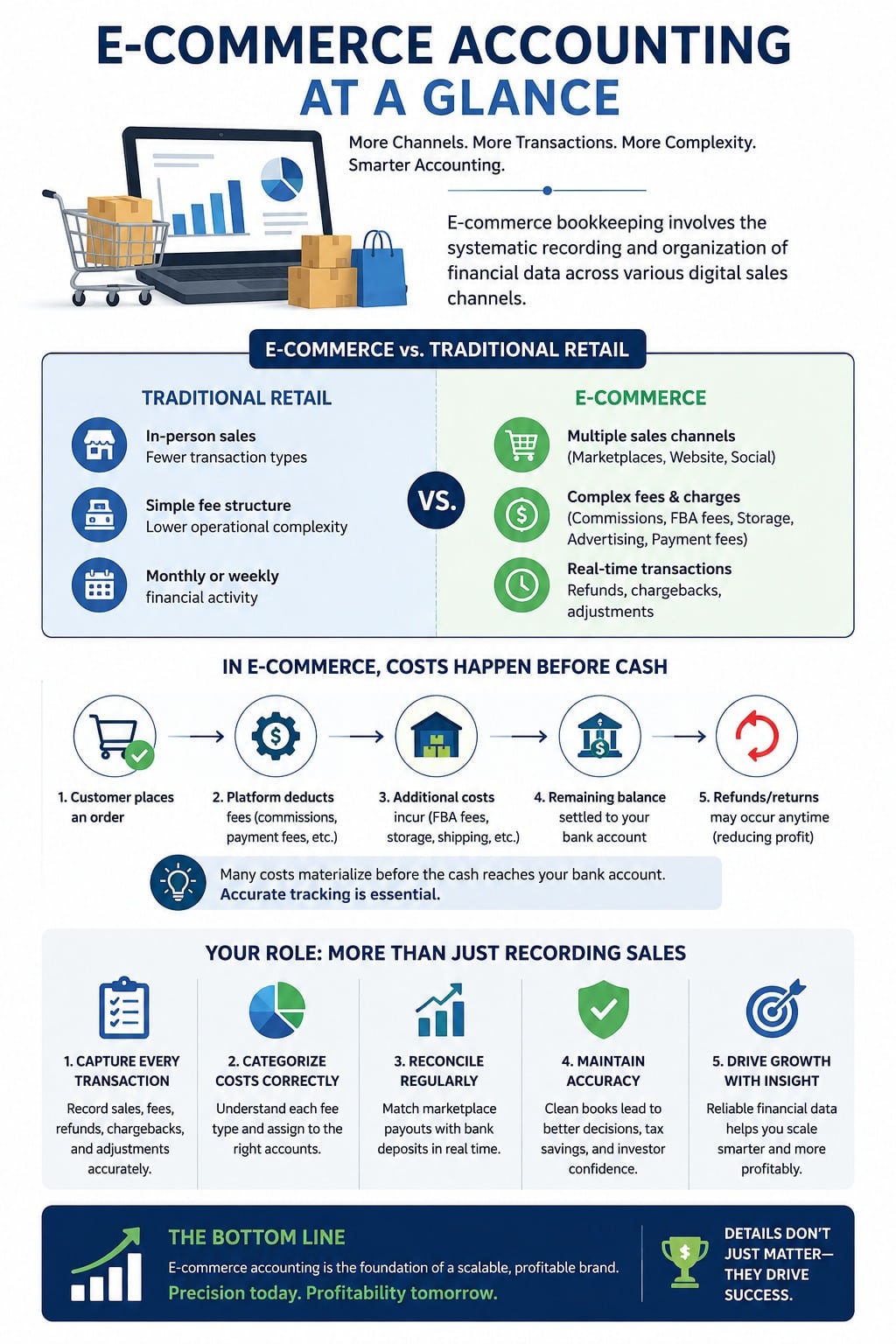
Infographic explaining ecommerce accounting, reconciliation, payout tracking, fees, refunds, and financial management for online sellers.
Conclusion
Establishing a resilient business transcends mere sales volume. It necessitates the transformation of raw data into actionable insights, enabling you to navigate market fluctuations adeptly.
At the core of every critical decision lies effective E-commerce bookkeeping USA. Prioritizing precise records empowers you to discern which products catalyze growth and which consume resources.
Enhancing your Online seller accounting practices enables trend identification before they affect your cash flow. This forward-thinking strategy transforms your ledger into a dynamic tool for expansion, transcending its role as a mere historical record.
We encourage you to scrutinize your current workflows immediately. Committing to robust E-commerce financial management safeguards your profit margins and fortifies your brand against the hurdles of scaling. Adherence to data-driven practices is the cornerstone of success in the fiercely competitive digital arena. Initiate the optimization of your financial health today to guarantee sustained profitability for your enterprise.
This guide is designed to help Shopify, Amazon FBA, Walmart Marketplace, and TikTok Shop sellers in the United States improve financial visibility, maintain tax compliance, and scale profitably using accurate ecommerce bookkeeping systems.