
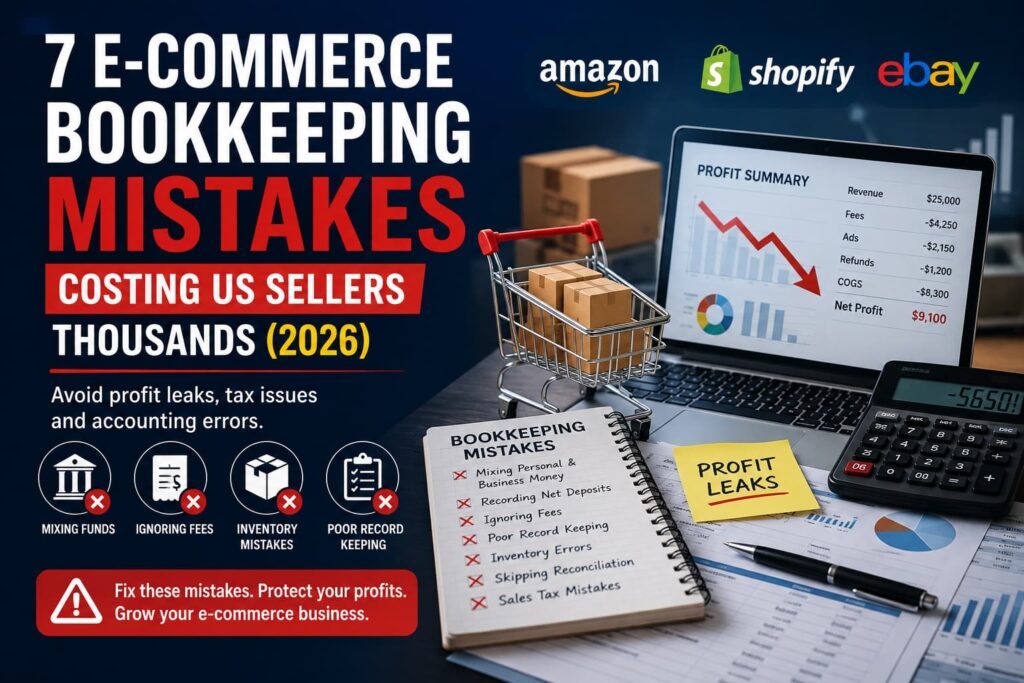
For any e-commerce entrepreneur, there is no sound more satisfying than the chaching of a new order notification. Whether you are selling on Amazon, Shopify, or eBay, seeing those daily sales climb gives you a sense of unstoppable success.
But then, the end of the month arrives. You log into your bank account, look at the balance, and a cold realization hits: “If I made so many sales this month, why is there almost no money left in my account?”
If you have ever felt this frustration, you aren’t alone. This is the Revenue Trap, the single biggest mistake online sellers make. You have the income, but without a professional Bookkeeping system, you are unknowingly losing thousands of dollars. Hidden marketplace fees, incorrect tax filings, and inventory errors are like tiny leaks in a ship. They may seem small, but they will eventually sink your business.
Are you tired of feeling like you’re working for free? Are you dreading the next tax season? Don’t panic. At JK Cloud Ledger, we specialize in turning financial chaos into clarity. In this guide, we’ll show you exactly where you’re losing money and how to fix it in seconds to maximize your take-home pay.
Let’s stop the guesswork and start building a business that actually rewards your hard work.
Mixing Personal and Business Money
This is the number one mistake beginners make. When you use a single bank account or credit card for both your morning coffee and your inventory purchases, your finances become a tangled mess. It becomes impossible to tell exactly what is a deductible business expense and what is a personal cost. Come tax time, this is a massive red flag for the
IRS.
The CFO INSIGHT and fix:
Mixing funds masks the true profitability of your store and puts you at risk of losing tax deductions because you simply can’t prove them.
The Fix: Open a dedicated business checking account and get a separate business credit or debit card immediately. Even if your business is brand new, keeping every single transaction strictly separated is your first step toward financial clarity.
Using structured
bookkeeping services and proper expense tracking tools like
QuickBooks Online can help ecommerce businesses maintain clean financial records from day one.
Recording Net Deposits Instead of Total Sales
When
Amazon or
Shopify deposits money into your bank account, it is easy to assume that the amount is your revenue. It isn’t. Those platforms take out their fees, refunds, and taxes before sending you the rest.
If you sell $10,000 worth of products, but the platform takes $700 in fees and refunds, your bank deposit will be $9,300. If you record $9,300 as your sales, your numbers are completely wrong.
The CFO INSIGHT and fix:
Recording only the bank deposit hides your true costs. You will never know exactly how much you are paying the platform to sell your products.
The Fix: Always record your Gross Sales (the full $10,000). Then, record the fees and refunds as separate expenses. Tools like
A2X can automate this process, syncing directly with your accounting software to break down these deposits automatically.
Using modern
ecommerce bookkeeping services helps sellers maintain accurate profit reporting and cleaner financial statements.
Ignoring Sneaky Marketplace Fees
Marketplace fees are the silent profit killers of e-commerce. Amazon FBA fees, Shopify subscription costs, payment processing charges, and ad spends take a massive bite out of your margins, sometimes up to 15% to 20% per sale. If you do not track these individually, you will think your business is highly profitable while your bank account sits empty.
The CFO INSIGHT and fix:
When you fail to track fees, you artificially inflate your profits on paper, which means you might end up paying taxes on money you never actually kept!
The Fix: Create specific categories in your accounting software for every type of fee (e.g, Amazon Referral Fees, Shopify Payment Fees). Review these monthly to ensure your product pricing actually covers the cost of selling on these platforms.
Platforms like
QuickBooks Online make it easier to organize and monitor ecommerce marketplace expenses accurately.
Skipping Monthly Bank Reconciliations
Reconciliation is just a fancy word for checking your math. It means comparing your bookkeeping records against your actual bank and credit card statements to make sure they match perfectly. When you skip this step, duplicate entries, missed expenses, and software glitches pile up.
The CFO INSIGHT and fix:
Leaving reconciliation until the end of the year guarantees panic, high accounting bills, and lost tax deductions. Errors left unchecked compound over time.
The Fix: Schedule 30 minutes at the end of every month to reconcile your accounts. Use software like
QuickBooks Online or
Xero, which automatically pulls in your bank data and highlights any mismatched numbers for you to review.
Consistent reconciliation is one of the most important parts of professional
bookkeeping services because it keeps your financial reports accurate year-round.
Losing Receipts and Poor Record-Keeping
If the IRS comes knocking and you cannot prove a business expense with a receipt, that deduction will be denied. You will end up owing back taxes and penalties. Storing receipts in a shoebox (or worse, losing them entirely) is a fast track to trouble.
The CFO INSIGHT and fix:
The rule of thumb is: No receipt, no proof. The IRS requires you to keep records for 3 to 7 years.
The Fix: Go completely digital. Use a receipt-scanning app (like
Dext or the built-in scanner on the QuickBooks app). The moment you buy something for the business, snap a picture. It automatically saves to the cloud, keeping you audit-proof.
Modern
ecommerce bookkeeping systems help online sellers organize receipts, expenses, and tax records in one centralized platform.
Inventory Mismanagement
For product-based sellers, inventory is your biggest cash expense. Two common mistakes happen here:
- Treating inventory purchases as an immediate expense instead of an asset.
- Failing to track how much stock you actually have left. If you guess your inventory value, your profit reports will be wildly inaccurate.
The CFO INSIGHT and fix:
Overestimating your inventory means you underreport your costs (and overpay taxes). Underestimating means you show phantom profits.
The Fix: Only record the cost of an item as an expense when that item actually sells (Cost of Goods Sold). Count your physical stock regularly and use an inventory management system (even a simple spreadsheet for beginners) to track what comes in and what goes out.
Using organized
ecommerce bookkeeping systems helps sellers maintain accurate inventory values and cleaner profit reports.
Ignoring Sales Tax Rules (2026 Updates)
Sales tax is complicated. Because of a law passed a few years ago (the Wayfair decision), if you sell enough products to customers in another state (usually around $100,000 in sales or 200 transactions), you must collect and pay sales tax to that state.
The CFO INSIGHT and fix:
Ignoring sales tax does not make it go away. States will come after you for the unpaid tax, plus heavy interest and penalties, wiping out your profits.
The Fix: Know your numbers. Track where your customers are located. If you hit a state’s limit, register for a tax permit there. The good news? Marketplaces like
Amazon and Etsy now collect and pay this tax for you in most states. However, if you sell on your own Shopify website, the responsibility is entirely yours.
You can also review official guidance from the
IRS Small Business Center to better understand ecommerce tax responsibilities.
📊 2026 Software Comparison Table
Choosing the right tool is half the battle. Here is how the top players stack up in 2026:
| Software | Best For | 2026 Starting Price | Key Advantage |
|---|---|---|---|
| QuickBooks Online | Growing Stores | ~$35/mo | Industry standard fits every app. |
| Xero | Global Sellers | ~$20/mo | Excellent multi-currency & clean UI. |
| Zoho Books | Startups | FREE (under $50k) | Great value for tiny businesses. |
| Wave | Side Hustles | FREE | Simple is best for low-volume sellers. |
| A2X (Add-on) | Must-Have | ~$19/mo | Automatically fixes Amazon/Shopify fees. |
Monthly Bookkeeping Flowchart
Follow this routine every month to keep your business healthy:
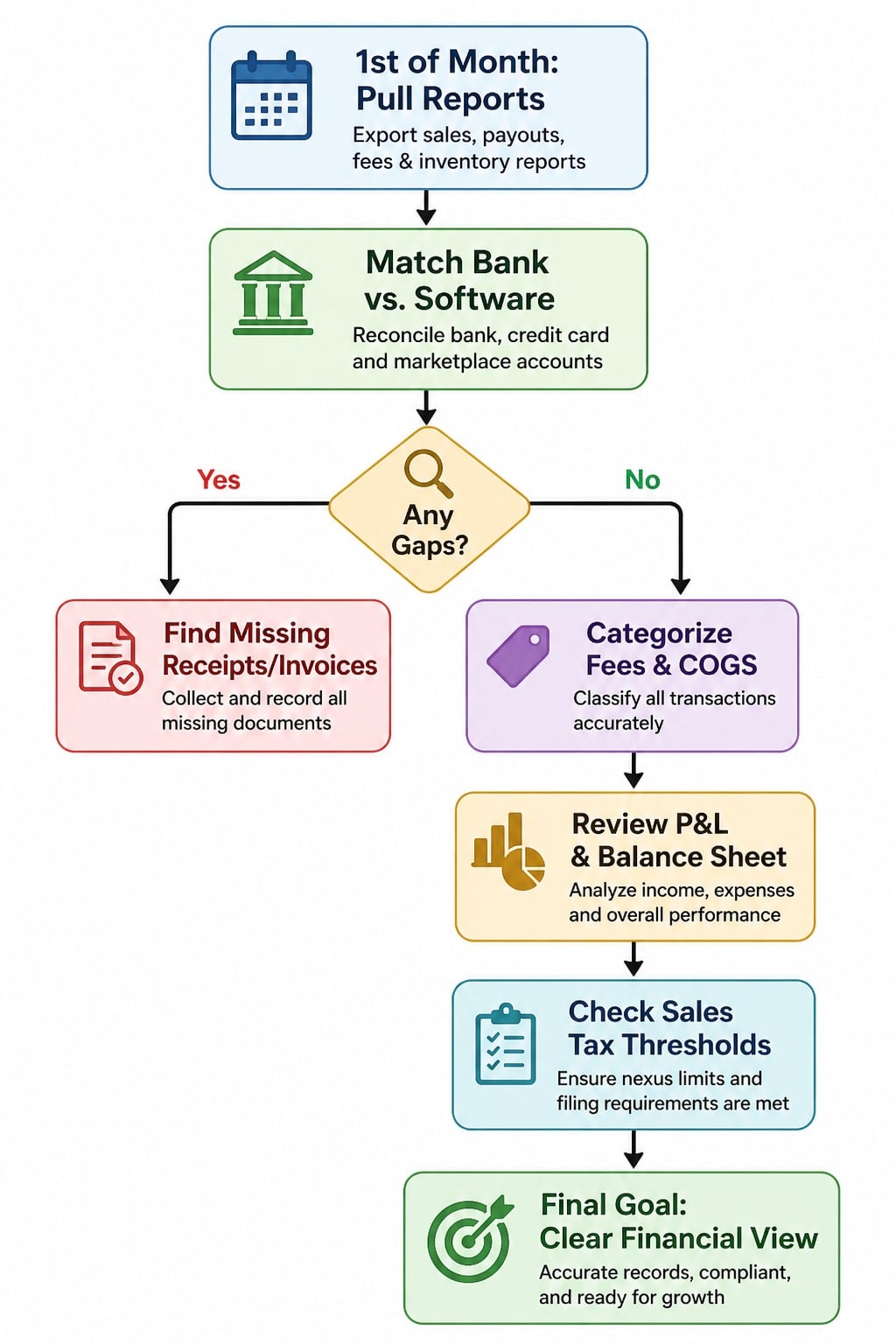
This monthly bookkeeping process helps ecommerce sellers maintain accurate financial records, track cash flow, and avoid costly reporting mistakes throughout the year.
The 2026 Tax Update: What You Need to Know
For 2026, two major changes affect US sellers:
- 1099-K Threshold: After years of confusion, the threshold has officially settled at $20,000 and 200 transactions. If you are below this, you might not get a form from
PayPal or Shopify, but you still must report every dollar of income to the
IRS. - Illinois Nexus: Note that Illinois has simplified its rules for 2026, removing the transaction count (200 sales) and focusing strictly on the dollar amount for remote sellers.
Understanding changing tax rules is a critical part of professional
ecommerce bookkeeping and compliance management.