Understanding Bookkeeping Costs for Small Businesses in 2026
(Why choosing the cheapest bookkeeping option can sometimes become the most expensive business decision.)
Did you know that many small businesses spend thousands of dollars every year on bookkeeping services without fully understanding what they are paying for? While some businesses can maintain accurate financial records for a few hundred dollars per month, others end up paying significantly more due to transaction volume, payroll complexity, inventory management, and reporting requirements. One of the biggest challenges facing business owners today is determining what bookkeeping should actually cost. Pricing structures vary widely across the industry, making it difficult to compare providers or identify whether a service offers genuine value. As a result, many businesses either overpay for bookkeeping services they do not need or underinvest in financial management, creating costly errors, compliance risks, and cash flow challenges. Accurate bookkeeping is no longer just an administrative task. It serves as the financial foundation of every successful business, providing the insights needed for budgeting, forecasting, tax planning, profitability analysis, and strategic decision-making. Without reliable financial records, even profitable businesses can struggle to maintain healthy cash flow and sustainable growth.[2] Whether you operate an ecommerce business, service-based company, real estate firm, SaaS startup, or growing small business, understanding the factors that influence bookkeeping costs can help you make smarter financial decisions while maximizing the return on your investment. In this guide, we will break down the average bookkeeping cost for small businesses in the United States, compare outsourced and in-house bookkeeping models, explore virtual bookkeeping pricing, examine the key factors that influence bookkeeping fees, and share practical strategies for reducing costs without sacrificing financial accuracy.
Key Takeaways
- Bookkeeping costs vary based on transaction volume, business complexity, and service requirements.
- Outsourced bookkeeping is often more cost-effective than hiring a full-time in-house bookkeeper.
- Virtual bookkeeping services provide flexible and scalable support for growing businesses.
- Understanding pricing factors helps businesses avoid overpaying for unnecessary services.
- Accurate bookkeeping supports stronger cash flow management, compliance, and long-term growth.
What Is the Average Cost of Bookkeeping for Small Businesses?
One of the most common questions business owners ask is:
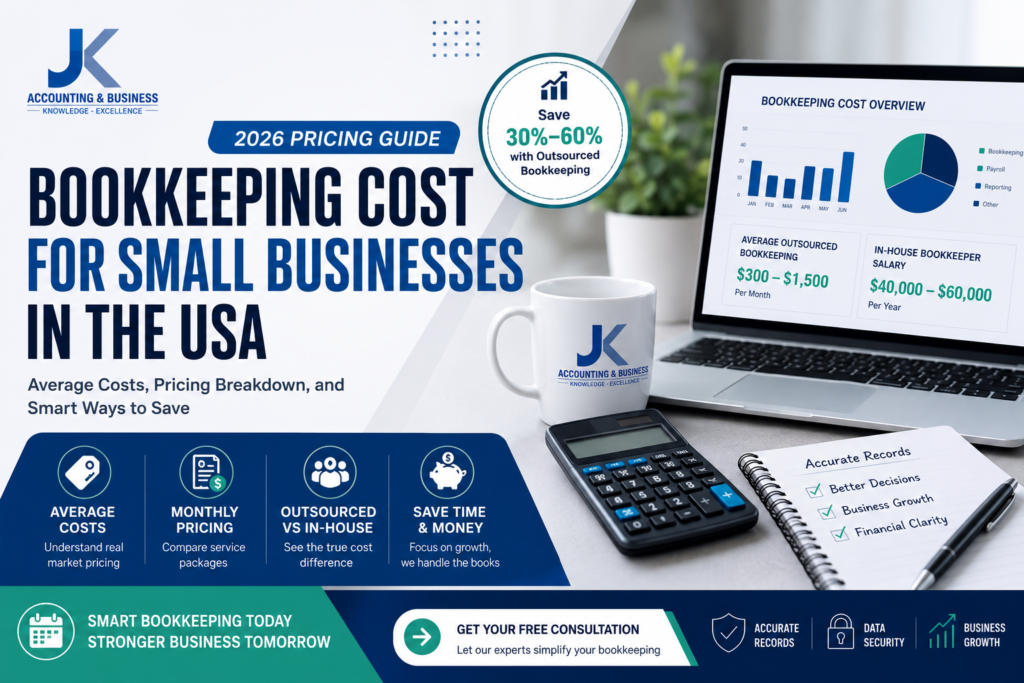
“How much should bookkeeping actually cost?” In 2026, most small businesses in the United States can expect to spend anywhere from
$200 to $2,500 per month on bookkeeping services, depending on transaction volume, payroll complexity, reporting requirements, inventory management, and overall business operations.
[1] Businesses with relatively simple financial operations often fall within the lower end of the pricing spectrum, while companies managing higher transaction volumes, multiple sales channels, payroll processing, and advanced reporting requirements typically require more comprehensive bookkeeping support. For freelancers, consultants, and micro-businesses, basic bookkeeping services generally range between
$200 and $400 per month. However, as a business expands, bookkeeping requirements often move beyond transaction recording and begin to include
Accounting & Financial Reporting, payroll processing, accounts payable and receivable management, tax-ready financial statements, and strategic financial support. Understanding these costs is important because bookkeeping should not be viewed solely as an administrative expense. Accurate financial records provide the visibility needed to manage cash flow, monitor profitability, maintain compliance, and make informed business decisions. Businesses that invest in reliable financial management often gain greater control over their growth strategy while reducing costly accounting errors and financial blind spots.
[2]Quick Facts on Bookkeeping Costs
| Metric | Cost Range |
|---|
| Average Outsourced Bookkeeping | $300 – $1,500/month |
| Average In-House Bookkeeper Salary | $40,000 – $60,000/year |
| Potential Cost Reduction Through Outsourcing | 30% – 60% |

Small business bookkeeping costs vary based on transaction volume, reporting requirements, payroll complexity, and overall business operations.
The
Internal Revenue Service (IRS) emphasizes the importance of maintaining accurate financial records for tax compliance, audit preparation, and effective business management.
[6] Businesses with organized bookkeeping systems are better positioned to track expenses, identify deductions, and make informed financial decisions. Academic research and industry experts, including insights from the
Wharton School, suggest that financial management should be viewed as an investment rather than a cost.
[2] Reliable bookkeeping provides the financial clarity needed for budgeting, forecasting, profitability analysis, and long-term strategic planning. Many growing businesses also find that outsourcing bookkeeping functions can reduce administrative overhead while providing access to specialized expertise.
[4] Businesses that combine professional bookkeeping with services such as
Payroll Management,
Catch-Up Bookkeeping, and
Virtual CFO Services often gain deeper financial visibility and stronger operational control.
Cost Insight: The cheapest bookkeeping service is not always the most cost-effective option. Businesses should evaluate providers based on reporting quality, accuracy, industry expertise, scalability, and the long-term value they bring to financial decision-making.
Monthly Bookkeeping Service Pricing
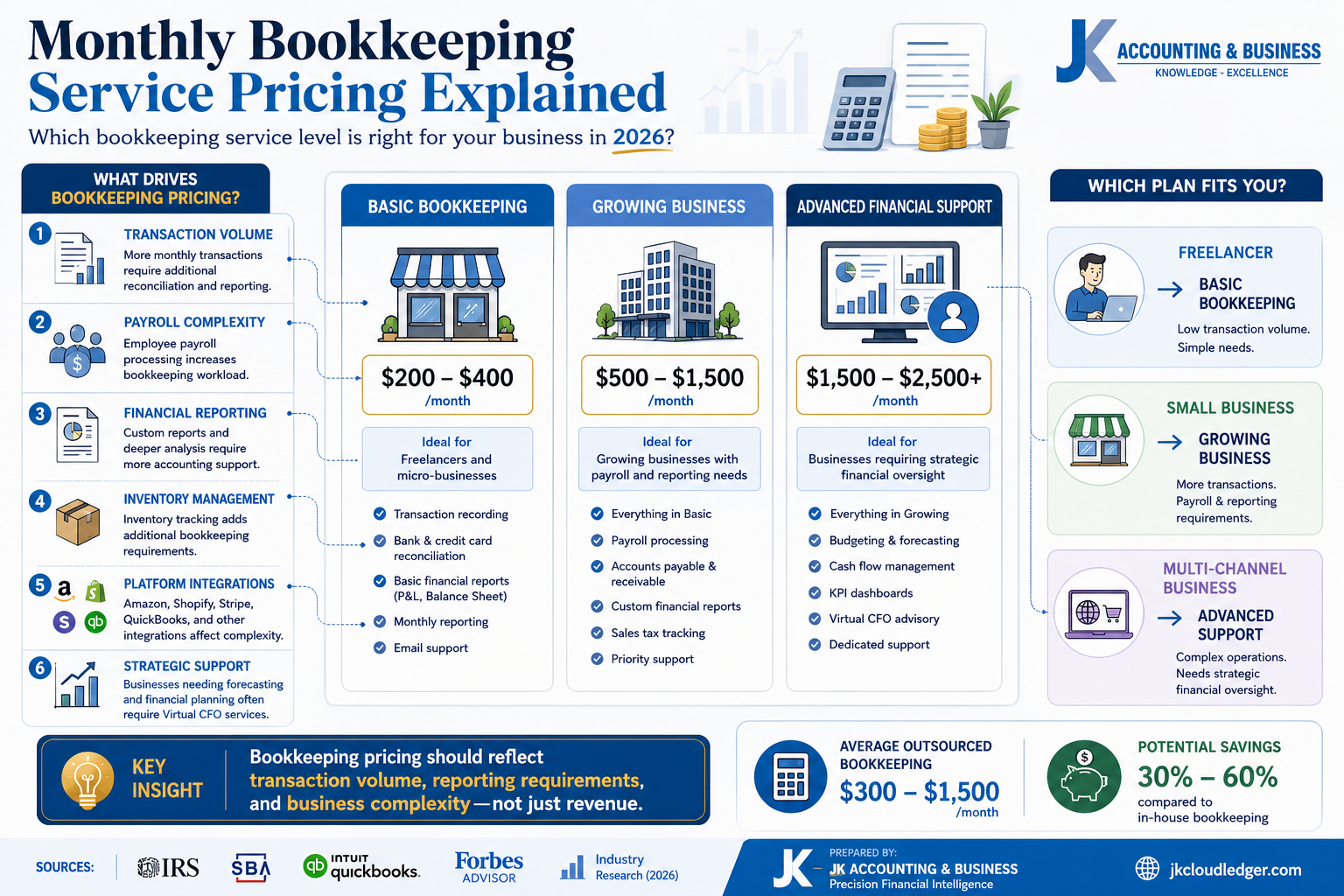
When evaluating bookkeeping providers, one of the most important considerations is understanding what level of service your business actually requires. Bookkeeping pricing can vary significantly depending on transaction volume, reporting requirements, payroll complexity, inventory management, and the level of financial oversight needed. Most bookkeeping providers structure their services into different tiers based on business complexity. While smaller businesses may only require basic reconciliation and monthly reporting, growing companies often need payroll support, accounts receivable management, and advanced financial reporting to maintain accurate financial visibility. The following pricing ranges provide a general overview of what small businesses can expect to pay for bookkeeping services in 2026.[1][5][9]
| Service Tier | Monthly Cost Range | Typical Services Included |
|---|
| Basic | $200 – $400 | Bank reconciliation, income and expense tracking, monthly financial statements (Profit & Loss and Balance Sheet). Ideal for freelancers and micro-businesses. |
| Mid-Range | $500 – $1,500 | Everything included in basic bookkeeping, plus accounts payable and receivable management, payroll processing, and more detailed financial reporting. |
| Comprehensive | $1,500 – $2,500+ | Full-service bookkeeping, advanced financial analysis, inventory tracking, custom reporting, and dedicated Virtual CFO Services for growing businesses requiring strategic financial guidance. |
Bookkeeping service pricing varies based on transaction volume, reporting requirements, payroll complexity, and the level of financial oversight required.
These pricing tiers demonstrate how bookkeeping services can scale alongside business growth. By selecting a service package that aligns with your current operational needs, businesses can control costs while maintaining accurate financial records and compliance. As companies expand, bookkeeping often evolves from basic transaction recording into a more strategic financial function. This may include forecasting, profitability analysis, KPI reporting, and executive-level financial support. Businesses requiring deeper financial insights often benefit from services such as
Virtual CFO Services, which provide strategic guidance without the cost of hiring a full-time CFO. For businesses that have fallen behind on bookkeeping, financial records can quickly become difficult to manage. In these situations, specialized
Catch-Up Bookkeeping services can help restore accurate records, resolve reconciliation issues, and bring accounts up to date before tax filing or financial reporting deadlines.
Pricing Insight: The right bookkeeping package is not always the cheapest option. Businesses should choose a service level based on reporting requirements, transaction complexity, and growth objectives rather than monthly cost alone.
Factors That Affect Bookkeeping Costs
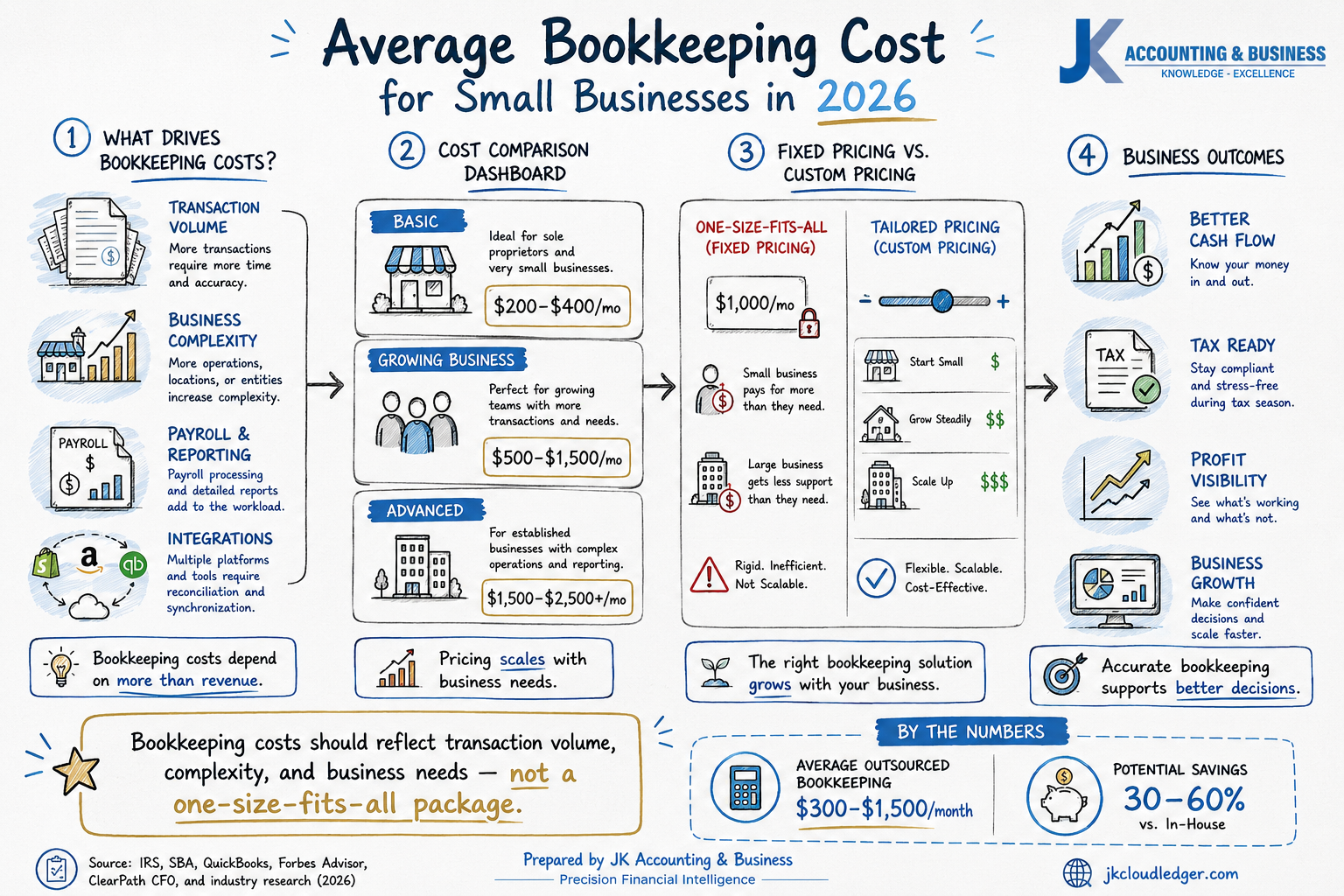
No two businesses have identical bookkeeping requirements. While average pricing ranges provide a useful benchmark, the actual cost of bookkeeping services depends on several operational and financial factors. Understanding these variables can help business owners anticipate expenses, select the right service package, and avoid paying for services they do not need. The following factors have the greatest influence on bookkeeping pricing for small businesses in 2026.
Transaction Volume
The number of monthly transactions is one of the most significant pricing factors in bookkeeping. Every sale, purchase, bank transfer, payroll entry, and expense transaction must be reviewed, categorized, and reconciled accurately. Businesses processing a few hundred transactions per month generally require less bookkeeping support than companies handling thousands of transactions across multiple sales channels. As transaction volume increases, the time required for reconciliation, reporting, and financial review also increases, leading to higher bookkeeping fees.[1][5]
Business Complexity
The complexity of a business significantly impacts bookkeeping costs. Companies with multiple revenue streams, inventory management requirements, subscription-based revenue models, or international operations typically require more advanced financial oversight. For example, ecommerce businesses often face unique bookkeeping challenges, including marketplace fees, inventory tracking, sales tax compliance, and payout reconciliation across multiple platforms. Businesses selling through Shopify, Amazon, Etsy, and TikTok Shop frequently require specialized bookkeeping workflows to maintain accurate financial records. Based on our experience working with ecommerce businesses, one client operating across Shopify, Amazon, and Etsy reduced their bookkeeping workload by nearly 40% after implementing automated integrations and reconciliation processes. This not only improved reporting accuracy but also reduced ongoing bookkeeping costs by eliminating manual data entry and duplicate work. To learn more about marketplace reconciliation challenges, explore our guide on
Amazon, Shopify & TikTok Shop Payout Reconciliation in QuickBooks Online.
Cost-Saving Tip: Businesses that automate data synchronization between ecommerce platforms and accounting software often reduce bookkeeping workloads, improve reporting accuracy, and lower long-term bookkeeping costs.
Service Scope
Bookkeeping pricing also depends on the range of services included in the engagement. Basic bookkeeping generally covers transaction categorization, bank reconciliation, and monthly financial statements. However, many businesses require additional support beyond these core services. Services such as
Payroll Management, invoicing, accounts payable and receivable management, budgeting, cash flow reporting, and financial analysis can increase the overall scope of work and influence pricing. As businesses grow, they often require more advanced financial guidance. Many companies supplement bookkeeping with
Virtual CFO Services to gain strategic insights into profitability, forecasting, and financial planning without hiring a full-time CFO.
Software and Technology
Modern bookkeeping relies heavily on cloud-based accounting software such as QuickBooks Online. While software subscriptions create an additional cost, they often improve efficiency through automation, bank feeds, real-time reporting, and integration capabilities. Businesses using modern accounting systems typically benefit from faster reconciliation processes, improved reporting accuracy, and greater visibility into their financial performance.[5]
Integrating platforms such as Shopify, Amazon, Etsy, Stripe, PayPal, and QuickBooks Online requires technical setup, ongoing monitoring, and periodic maintenance. While integrations can dramatically reduce manual bookkeeping work, they also require expertise to implement correctly. For businesses operating across multiple sales channels, integration management becomes an important component of bookkeeping services. Properly configured integrations improve financial accuracy, reduce reconciliation issues, and provide a more complete view of business performance.
“The true cost of bookkeeping is not determined by the number of transactions alone. It is determined by the complexity, accuracy requirements, and financial visibility needed to support business growth.”
Outsourced Bookkeeping vs In-House Bookkeeping Costs
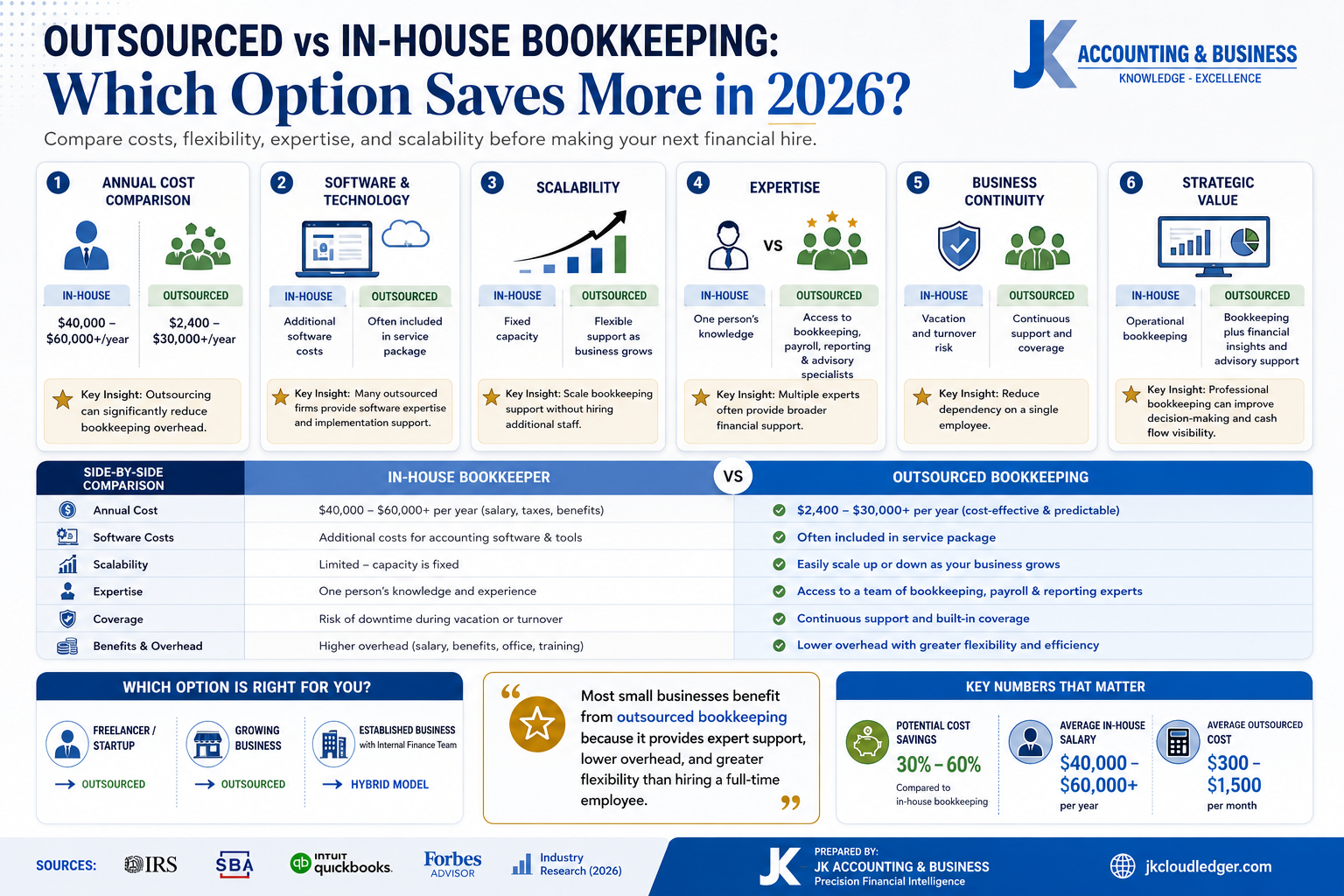
One of the most important financial decisions a small business owner will make is whether to hire an in-house bookkeeper or partner with an outsourced bookkeeping provider. While both options can help maintain accurate financial records, the cost structure, scalability, and expertise available through each model can vary significantly. For many small and growing businesses, outsourced bookkeeping provides access to professional expertise without the substantial costs associated with recruiting, training, and retaining a full-time employee. As a result, outsourcing has become an increasingly popular solution for businesses seeking both financial accuracy and operational efficiency.[3][4][8]
| Feature | In-House Bookkeeper | Outsourced Bookkeeping Service |
|---|
| Annual Cost | $40,000 – $60,000+ Salary | $2,400 – $30,000+ Annually |
| Software Costs | Additional Licenses & Updates | Often Included |
| Scalability | Limited | Highly Scalable |
| Expertise | Single Individual | Team-Based Specialists |
| Coverage | Single Resource | Continuous Support |
| Benefits & Overhead | Health Insurance, Taxes, Office Costs | No Additional Overhead |
Outsourced bookkeeping often provides greater flexibility, lower overhead costs, and access to specialized expertise compared to hiring a full-time in-house bookkeeper.
Hiring a full-time in-house bookkeeper in the United States typically costs between
$40,000 and $60,000 annually, excluding employee benefits, payroll taxes, recruiting expenses, software subscriptions, training costs, and office overhead.
[3][5] While this approach may be appropriate for larger organizations with complex accounting requirements, it can be financially challenging for smaller businesses. By comparison, outsourced bookkeeping services generally range from
$2,400 to $30,000 per year, depending on transaction volume, reporting requirements, and the level of support provided. This pricing flexibility allows businesses to scale financial services as they grow without committing to fixed employment costs.
[1][3][4] Research referenced by the
Harvard Business Review and industry studies suggests that outsourcing financial functions can reduce operational costs by as much as
30% to 60% while improving efficiency and allowing business owners to focus on core growth activities.
[4] Similarly, resources provided by the
U.S. Small Business Administration (SBA) emphasize the importance of efficient financial management practices when evaluating operational expenses.
[7] Beyond cost savings, outsourcing provides access to specialized expertise across bookkeeping, payroll, reporting, compliance, and financial strategy. Businesses can also supplement bookkeeping services with solutions such as
Virtual CFO Services to gain executive-level financial guidance without the cost of hiring a full-time CFO. As businesses grow, outsourced providers can easily adapt service levels to support increased transaction volume, new sales channels, and expanded reporting requirements. This flexibility is often difficult to achieve with a single in-house employee.
Cost-Saving Insight: For most small and medium-sized businesses, outsourcing bookkeeping provides the best balance of expertise, scalability, technology, and cost-efficiency while eliminating employee-related overhead expenses.
“Successful businesses do not simply look for the lowest bookkeeping cost. They look for the highest financial value, visibility, and expertise per dollar invested.”
Businesses that outsource bookkeeping can reduce finance-related operating costs by 30% to 60% while gaining access to specialized financial expertise.[4][8]
For businesses evaluating bookkeeping options, the question is often not whether outsourcing is cheaper, but whether the additional expertise, scalability, and financial visibility can create long-term value. For many growing businesses, the answer is yes.
Ready to Reduce Your Bookkeeping Costs?
Discover how professional bookkeeping and
Virtual CFO Services can help improve financial visibility while reducing administrative overhead.
Schedule a Free Consultation Why JK Cloud Ledger Fits Your Business Better Than Fixed Pricing
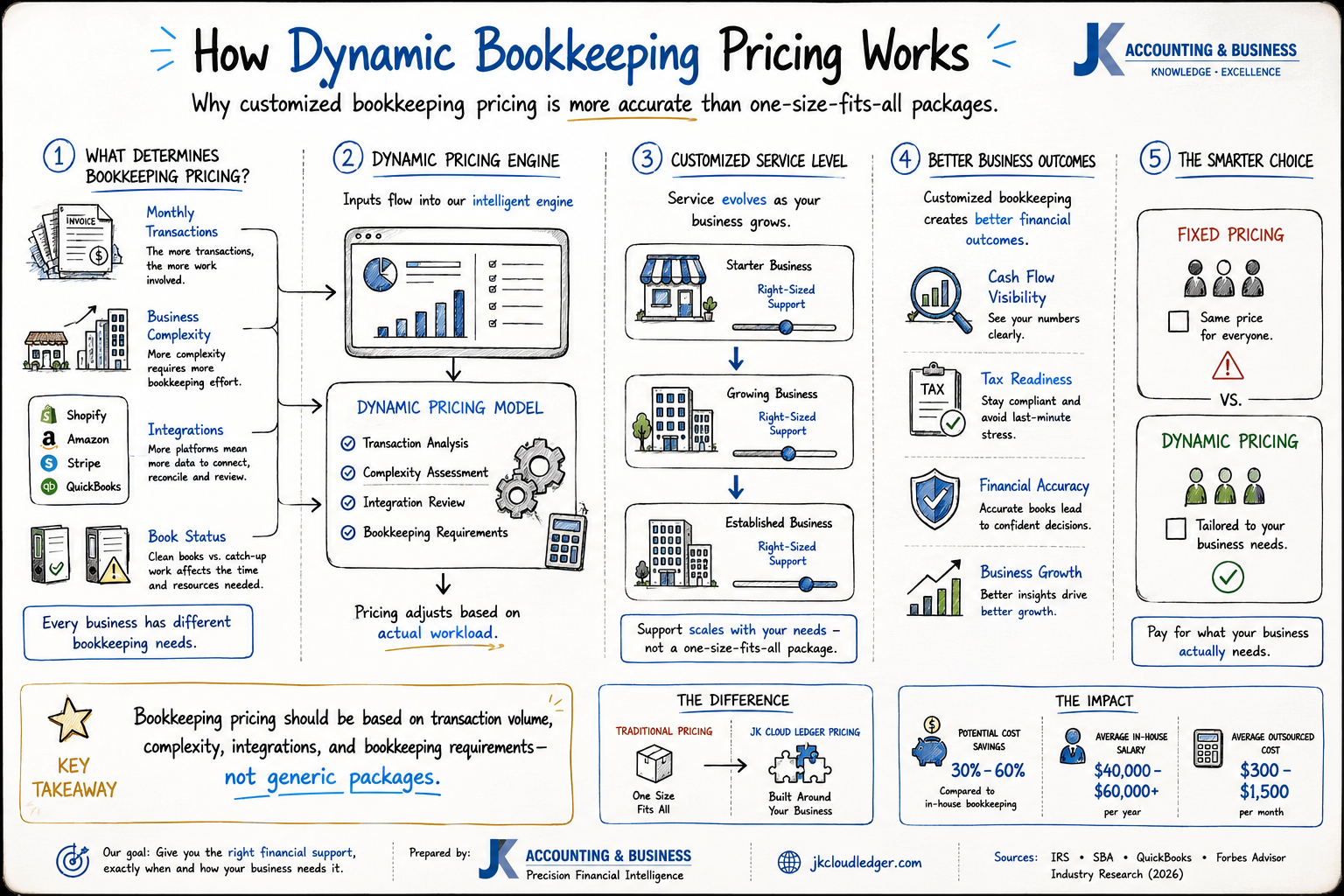
Many bookkeeping providers rely on fixed pricing models that fail to reflect the unique needs of each business. As a result, some companies end up paying for services they do not use, while others quickly outgrow their bookkeeping package and require costly upgrades. At JK Cloud Ledger, we take a different approach. Our philosophy is built around Precision Financial Intelligence, ensuring that bookkeeping services align with the actual complexity, workload, and growth stage of your business. Rather than forcing businesses into rigid pricing tiers, we develop customized solutions that scale alongside your operations. This approach allows growing businesses to maintain financial accuracy, improve visibility, and access the support they need without paying for unnecessary services.
Our Dynamic Pricing Pillars
Unlike traditional bookkeeping firms, our pricing model is built around four key factors that directly influence the amount of work required to maintain accurate financial records.
How We Determine Pricing
- Transaction Volume: Pricing reflects the actual number of transactions processed each month rather than applying a one-size-fits-all fee.
- Operational Complexity: Different industries have different bookkeeping requirements. Whether you operate in ecommerce, SaaS, real estate, or professional services, pricing is tailored to your operational needs.
- System Integrations: Businesses using platforms such as Shopify, Amazon, Stripe, PayPal, and QuickBooks often require specialized integrations and reconciliation workflows.
- Current State of Your Books: Whether you need ongoing bookkeeping, historical clean-up, or support through our Catch-Up Bookkeeping Services, pricing is adjusted to reflect the current condition of your financial records.
JK Cloud Ledger’s pricing model adapts to transaction volume, business complexity, integrations, and bookkeeping requirements instead of using rigid one-size-fits-all packages.
Scalability and Flexibility
One of the biggest advantages of partnering with JK Cloud Ledger is flexibility. As your business grows, your bookkeeping requirements naturally evolve. Our service model is designed to scale alongside your business, ensuring you always receive the level of support needed without paying for unnecessary services. For example, a growing SaaS business may initially require only transaction reconciliation and monthly reporting. As the company expands, additional services such as advanced financial reporting, KPI tracking, cash flow forecasting, and
Virtual CFO Services can be added seamlessly without disrupting operations. This scalable approach helps businesses maintain accurate financial records, improve decision-making, and gain deeper financial visibility as they grow.
Business Insight: The best bookkeeping solution is not necessarily the cheapest one. It is the solution that provides the right level of financial visibility, support, and scalability for your current stage of growth.
As businesses grow, bookkeeping requirements become more complex. A scalable bookkeeping solution helps maintain financial accuracy while supporting long-term growth.
Get a Customized Bookkeeping Quote
Every business is different. Speak with our team to receive a bookkeeping solution tailored to your transaction volume, operational complexity, and growth objectives.
Schedule a Free Consultation How Much Does a Virtual Bookkeeper Cost?
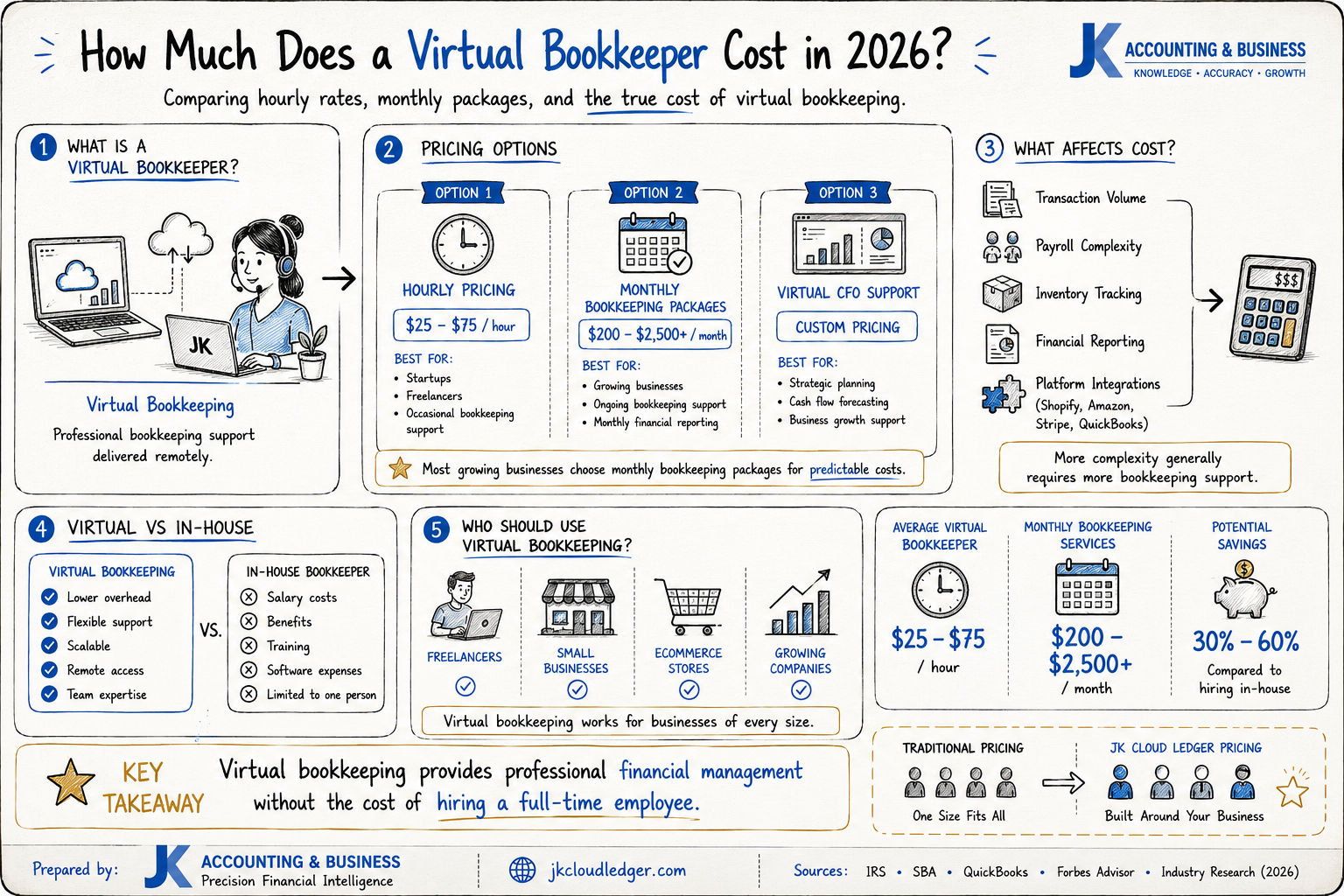
The growing adoption of cloud accounting software and remote work has made virtual bookkeeping one of the most popular financial management solutions for small businesses. Compared to hiring an in-house employee, virtual bookkeeping often provides greater flexibility, lower overhead costs, and access to specialized expertise without long-term employment commitments. In 2026, virtual bookkeepers typically charge between $25 and $75 per hour, while many firms offer fixed monthly bookkeeping packages that provide predictable pricing and ongoing support.[5][9] The exact cost depends on transaction volume, reporting requirements, industry complexity, and the level of bookkeeping support required. Unlike traditional in-house arrangements, virtual bookkeeping services allow businesses to scale support levels as needed. This flexibility is particularly valuable for startups, freelancers, and growing businesses that require professional financial oversight but do not yet need a full-time accounting team.
| Service Type | Typical Cost | Best For |
|---|
| Freelance Virtual Bookkeeper | $25 – $45/hour | Freelancers & Small Businesses |
| Professional Bookkeeping Firm | $50 – $75/hour | Growing Businesses |
| Monthly Fixed Package | $300 – $1,500+/month | Businesses Requiring Ongoing Support |
Virtual bookkeeping services provide flexible and scalable financial management support without the overhead costs associated with hiring full-time staff.
Many businesses combine virtual bookkeeping with strategic financial services such as
Virtual CFO Services to gain deeper visibility into cash flow, profitability, forecasting, and long-term financial planning. This approach allows companies to access executive-level financial expertise without the significant cost of hiring a full-time CFO. As cloud accounting technology continues to evolve, virtual bookkeeping is becoming the preferred solution for businesses seeking accurate financial records, real-time reporting, and scalable support while maintaining cost efficiency.
Virtual Bookkeeping Insight: Many small businesses only require a few hours of bookkeeping support each month. Virtual bookkeeping allows businesses to pay only for the services they need while maintaining professional financial oversight.
Bookkeeping Costs by Business Size
Bookkeeping costs vary significantly depending on business size, revenue, transaction volume, and operational complexity. While two businesses may generate similar revenue, differences in inventory management, payroll, sales channels, and reporting requirements can result in very different bookkeeping needs. The following estimates provide a general benchmark for bookkeeping costs based on business size and annual revenue.[1][5][9]
| Business Type | Annual Revenue | Typical Monthly Cost |
|---|
| Freelancers & Solopreneurs | Under $100K | $150 – $300 |
| Small Service Businesses | $100K – $500K | $300 – $800 |
| Growing Retail & Ecommerce Businesses | $500K – $2M | $800 – $2,000 |
| Established SMEs | $2M+ | $2,000 – $5,000+ |
Freelancers and solopreneurs generally require basic expense tracking, bank reconciliation, and tax-ready reporting. As businesses grow, bookkeeping requirements expand to include payroll processing, accounts receivable management, budgeting, and more detailed financial reporting. For growing ecommerce businesses, bookkeeping often becomes more complex due to inventory tracking, marketplace integrations, sales tax compliance, and payout reconciliation. Businesses selling through multiple channels such as Shopify, Amazon, Etsy, and TikTok Shop typically require more advanced financial workflows to maintain accurate reporting. To better understand ecommerce bookkeeping challenges, explore our guide on
Why Bookkeeping Matters for Ecommerce Businesses.
As businesses grow, bookkeeping costs typically increase due to higher transaction volumes, more complex reporting requirements, and additional financial management responsibilities.
Growth Insight: The goal is not to find the cheapest bookkeeping solution. The goal is to find a bookkeeping system that can scale alongside your business while maintaining financial accuracy and visibility.
How to Reduce Bookkeeping Costs
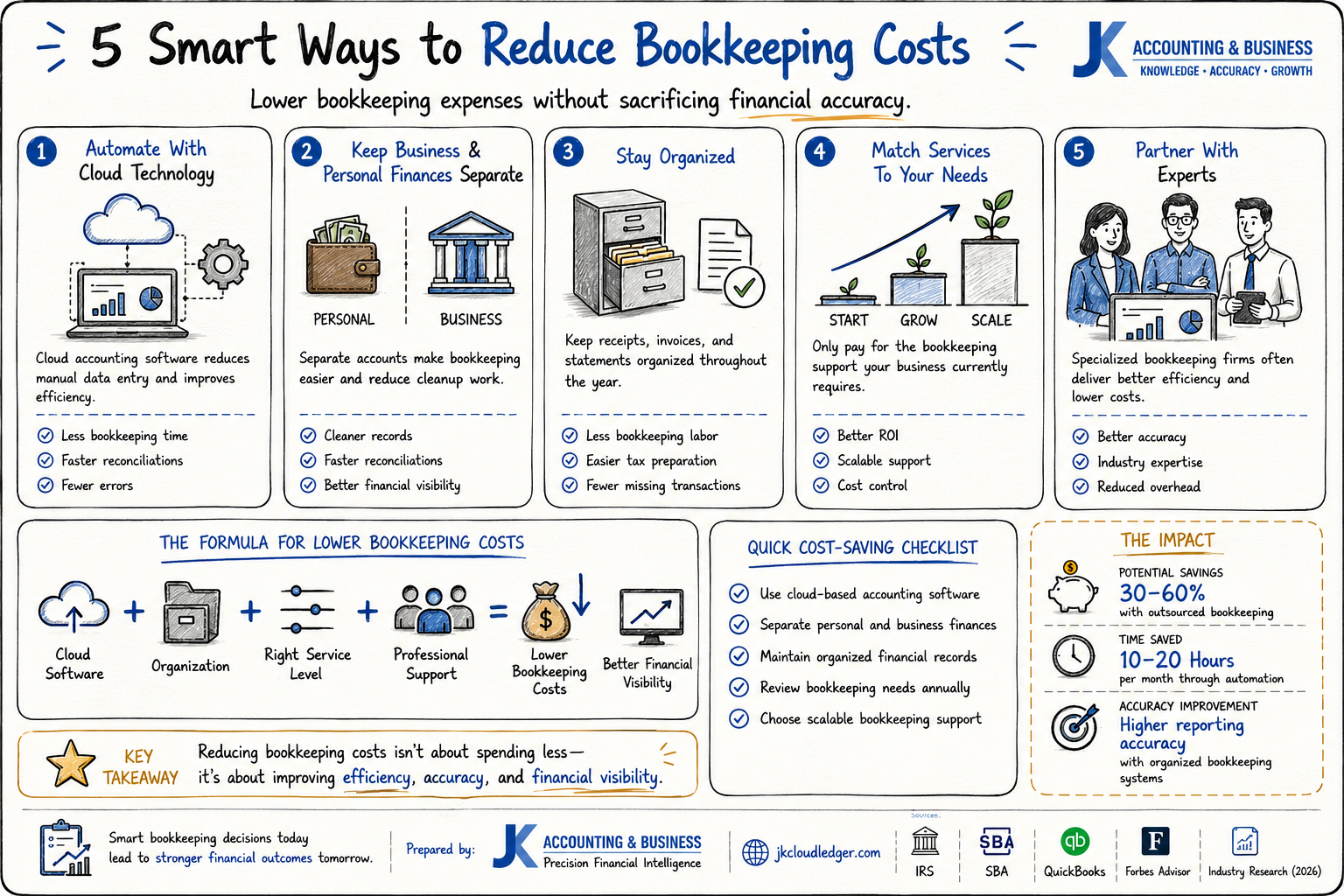
While professional bookkeeping is an essential investment, there are several practical strategies businesses can implement to reduce bookkeeping costs without sacrificing financial accuracy. By improving processes, leveraging technology, and maintaining organized financial records, businesses can significantly reduce the time and effort required to manage their books.[5][7] The goal is not to eliminate bookkeeping expenses but to create a more efficient financial management system that delivers maximum value for every dollar invested.
Embrace Cloud Accounting Technology
Cloud-based accounting platforms such as QuickBooks Online automate many time-consuming bookkeeping tasks, including transaction imports, bank feeds, expense categorization, and financial reporting. Automation reduces manual data entry while improving accuracy and efficiency.[5] Businesses that integrate their banking, payment processors, and sales platforms with their accounting software often experience lower bookkeeping costs because less manual reconciliation is required each month.
Keep Personal and Business Finances Separate
One of the most common bookkeeping challenges for small businesses is the mixing of personal and business transactions. When expenses are commingled, bookkeepers must spend additional time reviewing, categorizing, and correcting transactions. Maintaining separate business bank accounts and credit cards simplifies reconciliation, improves financial visibility, and reduces bookkeeping workloads throughout the year.[6]
Organize Financial Documentation
Providing organized receipts, invoices, vendor records, and bank statements allows your bookkeeping team to work more efficiently. Missing documentation often leads to delays, additional research, and increased bookkeeping costs. Establishing a consistent document management process helps ensure transactions are recorded accurately while reducing the time spent gathering information during month-end reviews.
Choose the Right Service Level
Many businesses overpay for bookkeeping because they purchase service packages that exceed their actual needs. A company requiring basic reconciliation and monthly reporting may not need advanced advisory services or executive-level financial planning. As your business grows, your bookkeeping requirements can evolve. Selecting a scalable service model allows you to increase support only when additional financial oversight becomes necessary.
Partner with a Specialized Bookkeeping Firm
Working with a specialized bookkeeping provider often delivers better value than attempting to manage financial records internally without dedicated expertise. Professional firms leverage technology, standardized workflows, and experienced specialists to improve efficiency and reduce costly financial errors. At JK Cloud Ledger, our bookkeeping solutions are designed around the unique needs of each business. By combining automation, industry expertise, and scalable support, we help businesses maintain accurate financial records while optimizing overall bookkeeping costs. Businesses requiring advanced forecasting, cash flow planning, and strategic financial guidance can also benefit from
Virtual CFO Services, providing executive-level financial insights without the cost of hiring a full-time CFO.
Businesses can reduce bookkeeping costs by leveraging cloud accounting technology, maintaining organized records, and selecting scalable bookkeeping services.
Quick Cost-Saving Checklist
- Use cloud-based accounting software.
- Separate personal and business finances.
- Maintain organized financial records.
- Choose a bookkeeping package that matches your current needs.
- Automate integrations between banking, ecommerce, and accounting platforms.
- Review bookkeeping processes regularly to identify inefficiencies.
Cost Optimization Insight: Businesses that maintain organized financial records and automate routine bookkeeping tasks often spend less on bookkeeping services while improving reporting accuracy and financial visibility.
“Reducing bookkeeping costs is not about spending less. It is about creating efficient financial processes that deliver greater value, visibility, and control.”
Final Thoughts on Small Business Bookkeeping Costs
Understanding the true bookkeeping cost for small businesses in 2026 is about more than comparing monthly fees. It is about identifying a financial management solution that provides accurate reporting, regulatory compliance, operational efficiency, and the financial visibility needed to support long-term growth. As we have explored throughout this guide, bookkeeping costs vary based on transaction volume, business complexity, reporting requirements, software integrations, and the level of financial support required. Whether you choose an in-house bookkeeper, a virtual bookkeeping solution, or an outsourced bookkeeping provider, the most important consideration is the value that financial clarity brings to your business. For many small and growing businesses, outsourcing bookkeeping offers a practical balance of expertise, scalability, and cost-efficiency. Access to professional bookkeeping support, modern accounting technology, and strategic financial insights allows business owners to focus on growth while maintaining confidence in their financial records.
[3][4][8] At JK Cloud Ledger, we help businesses move beyond basic bookkeeping by delivering
Precision Financial Intelligence. Our flexible service model is designed to adapt to your business, providing everything from day-to-day bookkeeping and
Catch-Up Bookkeeping to advanced
Virtual CFO Services and financial reporting support.
Final Takeaways
- Most small businesses spend between $200 and $2,500 per month on bookkeeping services.
- Transaction volume and business complexity are the primary drivers of bookkeeping costs.
- Outsourced bookkeeping is often more cost-effective than hiring an in-house employee.
- Virtual bookkeeping provides flexibility and scalability for growing businesses.
- Accurate financial records support better decisions, stronger cash flow, and sustainable growth.
The most valuable bookkeeping solution is not necessarily the least expensive—it is the one that provides the greatest financial visibility, accuracy, and long-term business value.
Ready to Simplify Your Bookkeeping?
Discover how JK Cloud Ledger can help you reduce bookkeeping complexity, improve financial visibility, and scale your business with confidence.
Schedule a Free Consultation