The Payout Reconciliation Gap: Why Ecommerce Sellers Misreport Revenue
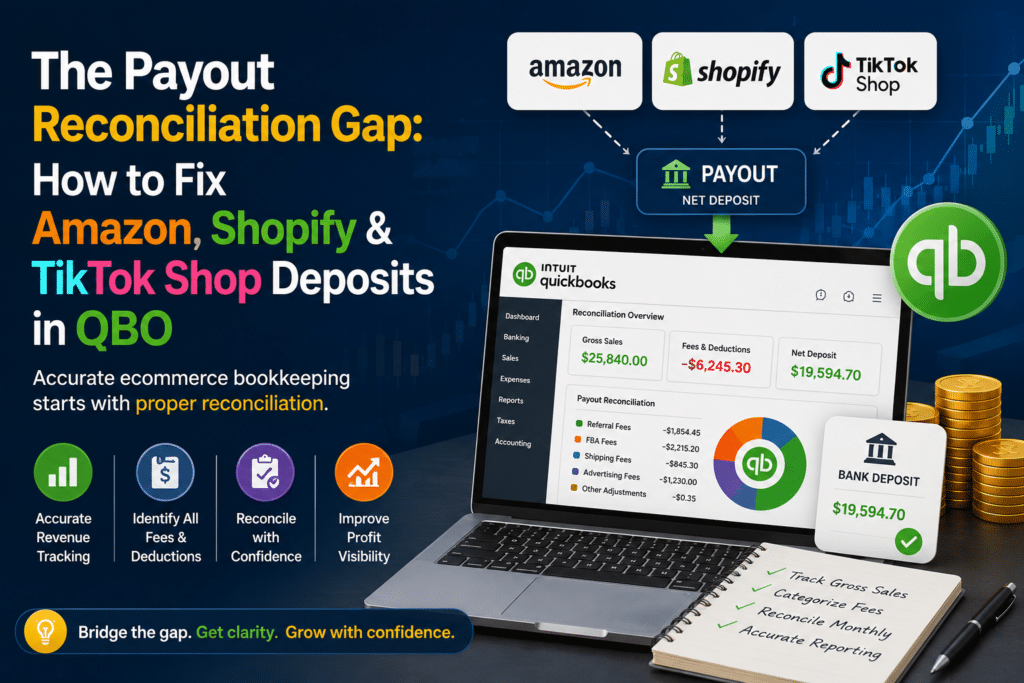
Amazon payout reconciliation QuickBooks Online workflows help ecommerce sellers accurately track marketplace deposits, fees, and profitability.Did you know that nearly
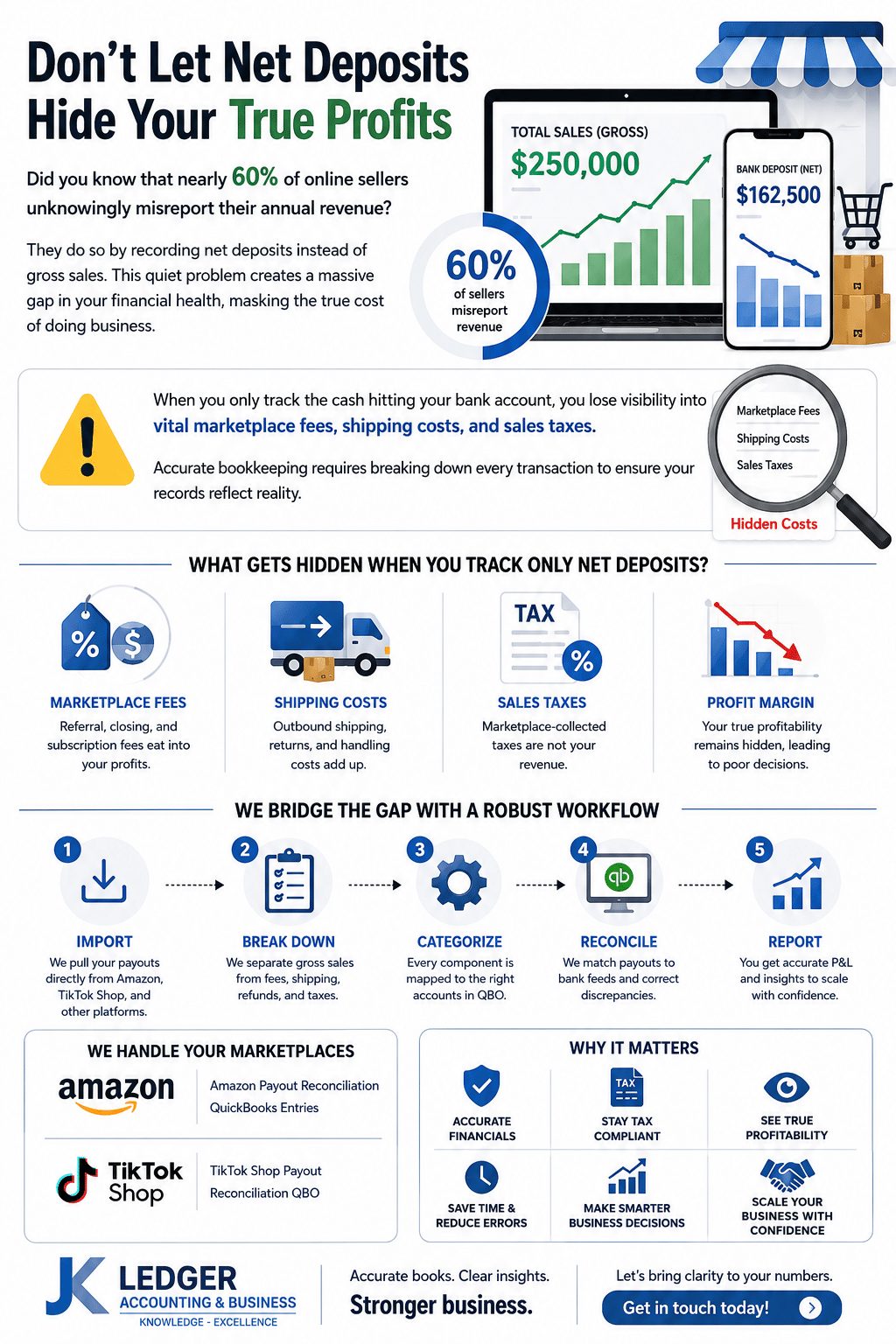
60% of online sellers unknowingly misreport their annual revenue?
Many ecommerce businesses record
net deposits instead of gross sales,
creating a dangerous visibility gap in their financial reporting.When you only track the cash hitting your bank account, you lose visibility into
marketplace fees, shipping costs, refunds, and sales taxes.
Accurate ecommerce bookkeeping requires breaking down every transaction
so your records reflect the true health of your business.At
JK Cloud Ledger
,
we help ecommerce businesses bridge this gap using structured reconciliation workflows for
Amazon, Shopify, and TikTok Shop sellers. Whether you are managing
Amazon payout reconciliation,
reviewing QuickBooks Online entries, or improving your
TikTok Shop payout reconciliation QBO workflow,
accurate reporting creates the clarity needed to scale confidently.
Key Takeaways
- Net deposits often hide critical data such as marketplace fees and taxes.
- Gross sales reporting is essential for accurate tax compliance and profitability analysis.
- Automated reconciliation workflows reduce manual bookkeeping errors.
- Proper categorization improves visibility into your ecommerce profit margins.
- Consistent reconciliation aligns bank deposits with actual sales performance.

Recording only net marketplace deposits can hide fees, taxes, shipping costs, and true ecommerce profitability inside QuickBooks Online.
The Hidden Cost of the Payout Reconciliation Gap
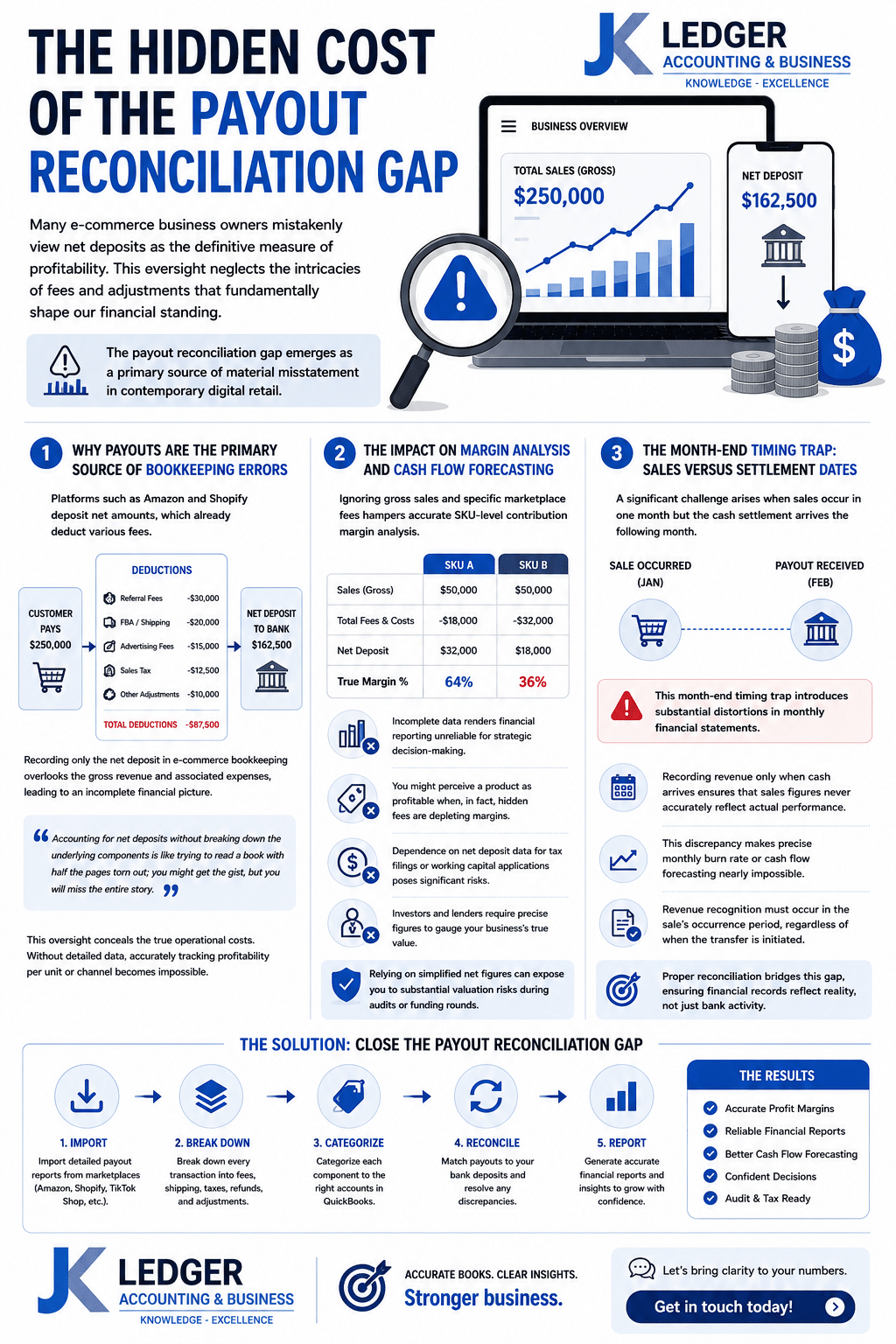
Many ecommerce business owners mistakenly treat
net deposits as the true measure of profitability.
This approach ignores marketplace fees, advertising costs, shipping expenses,
and financial adjustments that directly impact business performance.The result is what accountants often call the
payout reconciliation gap
— one of the leading causes of inaccurate ecommerce financial reporting.
Why Payouts Are the Primary Source of Bookkeeping Errors
Platforms like
Amazon,
Shopify,
and
TikTok Shop
deposit net amounts after automatically deducting referral fees, fulfillment charges, shipping costs, refunds, and advertising expenses.When sellers record only the final deposit inside
QuickBooks Online
,
they overlook critical gross revenue and expense data, resulting in incomplete ecommerce bookkeeping records.
“Accounting for net deposits without breaking down the underlying components
is like trying to read a book with half the pages torn out.”
Without detailed reconciliation data, tracking profitability by SKU, sales channel,
or advertising campaign becomes nearly impossible.
Hidden operational costs slowly erode margins without being visible in financial reports.
The Impact on Margin Analysis and Cash Flow Forecasting
Ignoring gross sales and marketplace fees weakens accurate
SKU-level profitability analysis.
Many ecommerce sellers assume products are profitable while hidden fulfillment and platform fees quietly reduce margins.Incomplete financial reporting also creates risks during
tax filings, investor reviews, and funding applications.
Banks and lenders rely on accurate financial statements to evaluate business health and long-term sustainability.Simplified net-deposit accounting can create major valuation risks during audits or future acquisition opportunities.
The Month-End Timing Trap: Sales Versus Settlement Dates
Another major challenge appears when a sale occurs in one month,
but the marketplace settlement arrives in the following month.Recording revenue only when cash reaches the bank account creates distortions in monthly financial reporting.
This makes accurate cash flow forecasting and monthly performance analysis extremely difficult.Proper ecommerce reconciliation workflows ensure revenue is recognized
during the correct accounting period — not simply when the payout is deposited.
Ecommerce payout reconciliation gaps can hide marketplace fees, distort profit margins, and create inaccurate financial reporting inside QuickBooks Online.
Mastering TikTok Shop Payout Reconciliation QBO and Amazon Payout Reconciliation QuickBooks
One of the biggest challenges for ecommerce sellers is transforming
marketplace deposits into clean, accurate accounting records.A single payout from platforms like Amazon, Shopify, or TikTok Shop
often combines gross sales, refunds, advertising deductions, fulfillment costs, and platform fees into one net deposit.Without a structured reconciliation workflow, your financial statements may fail to reflect the true financial health of your ecommerce business.
Understanding the Multi-Channel Payout Structure
Marketplaces rarely deposit the full gross sales amount directly into your bank account.
Instead, they deduct referral fees, fulfillment charges, refunds, payment processing costs, and advertising expenses before releasing payouts.This net-deposit structure hides critical operational metrics that ecommerce businesses rely on for strategic decision-making.Whether you are handling
TikTok Shop payout reconciliation QBO
workflows or managing
Amazon payout reconciliation in QuickBooks Online,
the goal is to separate gross revenue from operational expenses to reveal true profitability.
Standardizing Journal Entry Formats for Marketplace Deposits
Consistency is essential for maintaining audit-ready ecommerce financial records.Using standardized journal entry templates for every settlement period helps ensure that marketplace fees, advertising costs, fulfillment charges, and refunds are categorized correctly.By mapping these deductions into dedicated expense accounts inside
QuickBooks Online
,
ecommerce businesses gain cleaner Profit and Loss statements and more reliable financial reporting.Structured journal entries also simplify profitability analysis across multiple sales channels and reduce long-term bookkeeping inconsistencies.
Common Reconciliation Errors and How to Catch Them Early
Even experienced ecommerce sellers frequently encounter reconciliation mistakes that distort financial reporting.One common issue is incorrectly recording marketplace-facilitated tax remittances as sales revenue. Another major problem occurs when businesses fail to account for timing differences between sales dates and payout settlement dates.Monthly reviews of clearing accounts help identify discrepancies early before they evolve into larger accounting issues.Proactive reconciliation workflows improve financial accuracy, reduce reporting risks, and ensure your books remain aligned with marketplace settlement reports year-round.
Pro Tip:
Businesses that reconcile marketplace settlements monthly often identify hidden fee leakage and reporting inaccuracies before they impact taxes or cash flow forecasting.
Step-by-Step Guide to Manual Reconciliation in QuickBooks Online
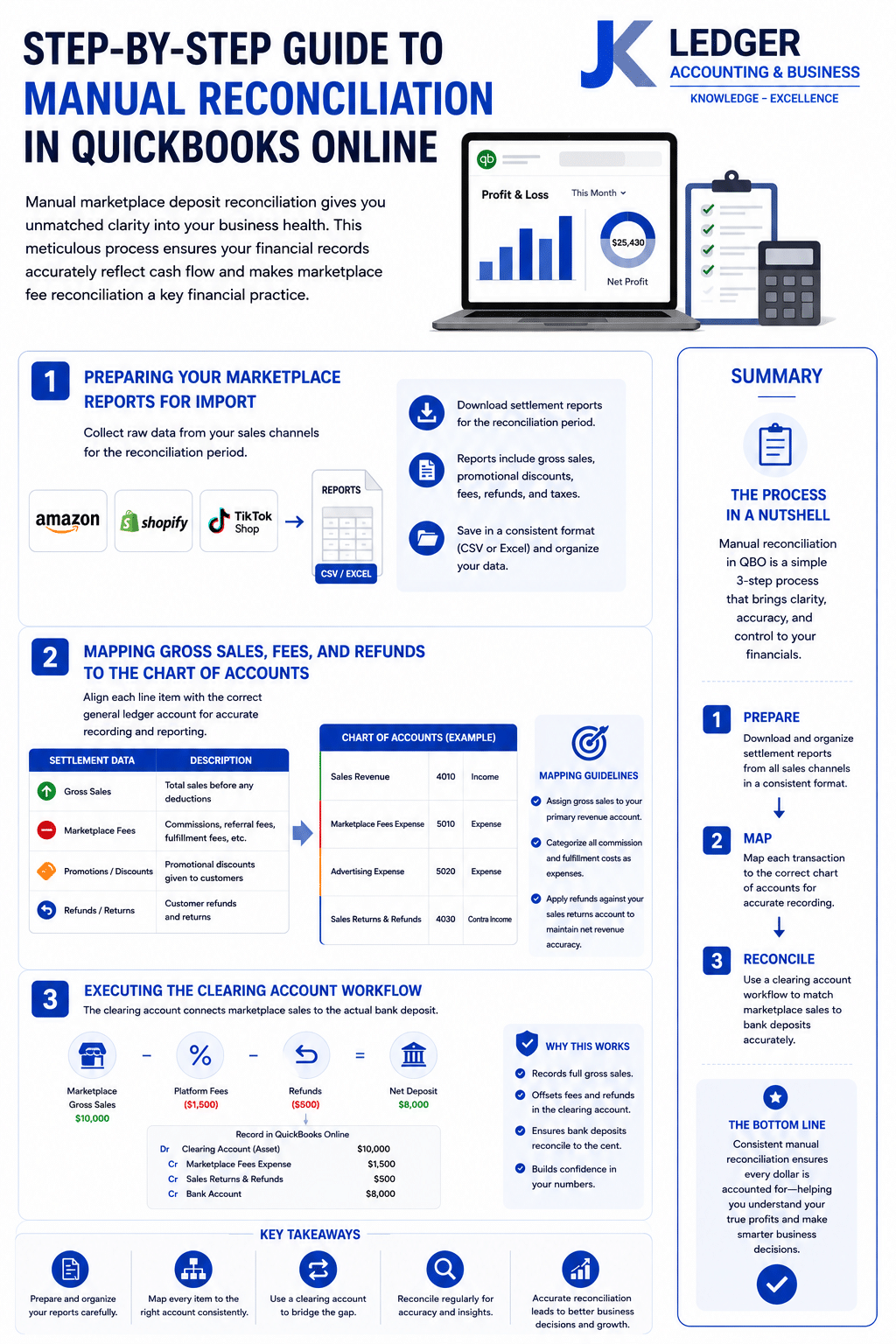
Many ecommerce sellers improve profitability visibility through
manual marketplace reconciliation workflows.Although automation tools simplify accounting processes, manually reconciling marketplace deposits often provides deeper insight into cash flow behavior, platform fees, and operational expenses.A structured reconciliation process ensures that your financial records accurately reflect real marketplace activity inside
QuickBooks Online
.
Preparing Your Marketplace Reports for Import
The reconciliation process begins with collecting raw settlement data from your ecommerce platforms.Download settlement reports covering the reconciliation period from Amazon, Shopify, TikTok Shop, or other marketplace channels. These reports typically include gross sales, refunds, promotional discounts, fulfillment fees, and processing charges.Saving these reports in structured formats such as
CSV or
Excel spreadsheets
simplifies imports and minimizes reconciliation errors later in the process.Organized financial data creates cleaner bookkeeping workflows and significantly reduces manual entry mistakes.
Mapping Gross Sales, Fees, and Refunds to the Chart of Accounts
Once your marketplace reports are prepared, the next step is mapping every transaction to the correct chart of accounts category.Proper account mapping improves visibility into gross revenue, marketplace expenses, and customer refunds while supporting accurate ecommerce profitability analysis.Consistent categorization is essential for effective
marketplace fee reconciliation
and long-term financial accuracy.
- Assign gross sales to your primary revenue account.
- Categorize commission fees and fulfillment costs as operational expenses.
- Apply refunds against your sales returns account to maintain net revenue accuracy.
Executing the Clearing Account Workflow
The clearing account workflow acts as the bridge between marketplace activity and actual bank deposits.Instead of recording only the final payout, clearing accounts capture gross sales while separately tracking fees, refunds, taxes, and settlement deductions.This process ensures that deposits inside your bank feed match marketplace settlements accurately down to the cent.Regular reconciliation of clearing accounts improves bookkeeping accuracy, strengthens cash flow visibility, and supports better long-term business decisions.
Pro Tip:
Reconcile marketplace clearing accounts monthly instead of waiting until year-end. Smaller reconciliation windows make accounting discrepancies significantly easier to identify and fix.
Manual reconciliation workflows help ecommerce sellers accurately organize marketplace deposits, fees, refunds, and financial reporting inside QuickBooks Online.
Evaluating Automated Solutions for Settlement Accounting
As ecommerce businesses scale, manual bookkeeping workflows eventually become difficult to manage efficiently.Higher transaction volume increases the risk of reconciliation errors, duplicate entries, and inaccurate reporting — especially in
Shopify settlement accounting
and multi-channel marketplace bookkeeping.Automated settlement accounting solutions help ecommerce businesses improve financial accuracy, reduce manual workload, and maintain audit-ready records as they grow.
Using Settlement Parsers Like A2X and Link My Books
Settlement parsers act as the bridge between ecommerce marketplaces and accounting software.Platforms such as
A2X
and
Link My Books
automatically retrieve payout data and generate structured journal entries for ecommerce businesses.These tools help ensure that marketplace fees, refunds, taxes, and settlement adjustments are accurately recorded inside your accounting system.
“Automation is not just about saving time — it is about building a reliable financial system that scales with your business growth.”
Automated settlement parsers reduce manual bookkeeping workload while improving financial consistency across multiple ecommerce sales channels.
Some ecommerce businesses prefer dedicated accounting platforms built specifically for online retail operations.These systems integrate directly with ecommerce marketplaces and provide real-time visibility into profitability, expenses, and settlement activity.Unlike traditional bookkeeping systems, purpose-built ecommerce accounting platforms are designed to handle the complexity of
Shopify settlement accounting,
Amazon settlements, and multi-channel reconciliation workflows.Consolidating reporting and reconciliation into a single ecosystem often improves operational efficiency and simplifies long-term financial management.
Implementing CPA-Built Templates for Custom Reporting
Businesses with advanced reporting requirements may benefit from CPA-built reconciliation templates tailored to their operational structure.Custom templates provide greater flexibility than standard off-the-shelf software and allow businesses to align financial reporting with internal KPIs and profitability goals.
- Customize reports around your internal performance metrics.
- Scale reporting structures as your ecommerce business grows.
- Maintain greater control over financial workflows and data visibility.
The ideal settlement accounting solution depends on your transaction volume, operational complexity, and reporting requirements. Whether you choose automation software or custom financial workflows, the ultimate objective remains the same — achieving complete financial clarity.
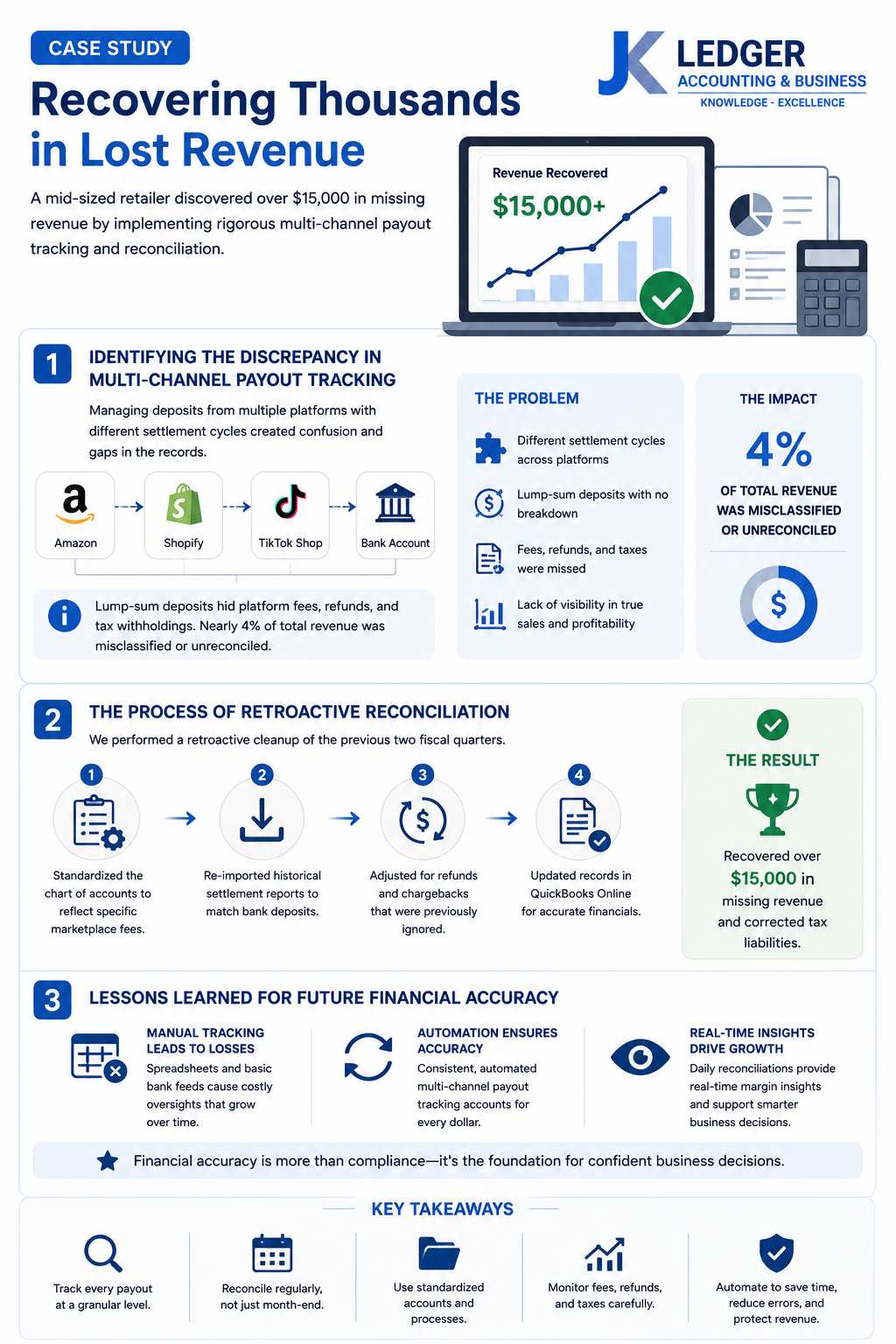
Case Study: Recovering Thousands in Lost Revenue
A rapidly growing mid-sized ecommerce retailer uncovered more than
$15,000 in unreconciled revenue
after conducting a detailed review of their financial records.As the business expanded across Amazon, Shopify, and TikTok Shop, its accounting workflows struggled to keep pace with increasing transaction complexity.Implementing structured
multi-channel payout tracking
revealed significant reconciliation gaps that had remained hidden for months.
Identifying the Discrepancy in Multi-Channel Payout Tracking
The primary challenge stemmed from managing deposits across multiple ecommerce platforms simultaneously.Amazon, Shopify, and TikTok Shop each operate on different settlement schedules, making it difficult to accurately match bank deposits against marketplace sales reports.Without a centralized reconciliation workflow, the business recorded lump-sum deposits without properly accounting for marketplace fees, refunds, tax withholdings, and chargebacks.This lack of financial visibility created the false impression that bank deposits accurately reflected total sales performance.
Nearly 4% of total marketplace revenue was either misclassified or unreconciled.
The Process of Retroactive Reconciliation
To correct these discrepancies, a complete retroactive reconciliation process was performed across the previous two fiscal quarters.Every marketplace transaction was carefully mapped into
QuickBooks Online
clearing accounts to restore accurate financial reporting.This reconciliation process created a significantly clearer picture of profitability while correcting previously inaccurate tax reporting.
- Standardized the chart of accounts to reflect marketplace-specific fees and deductions.
- Re-imported historical settlement reports to accurately match bank deposits.
- Adjusted refunds, chargebacks, and tax withholdings that had previously been ignored.
Lessons Learned for Future Financial Accuracy
One of the biggest lessons from this case study was the limitation of relying solely on spreadsheets or basic bank-feed bookkeeping workflows.As ecommerce businesses scale, manual tracking methods often create hidden accounting inconsistencies that compound over time.Consistent automated reconciliation workflows provide significantly greater visibility into marketplace activity, settlement adjustments, and profitability trends.After implementing automated settlement parsing tools, the business reduced manual reconciliation time substantially while gaining real-time visibility into operational margins and financial performance.Financial accuracy is more than a compliance requirement — it is a strategic advantage for long-term ecommerce growth.
Structured multi-channel payout reconciliation helped recover over $15,000 in previously unreconciled ecommerce revenue.
Calculating the ROI of Accurate Reconciliation
High-performing ecommerce brands no longer treat reconciliation as a simple bookkeeping task.Accurate reconciliation workflows have evolved into a strategic financial asset that improves operational visibility, reduces costly reporting errors, and supports long-term business growth.For scaling ecommerce businesses, reconciliation is no longer just about compliance — it directly impacts profitability, financial clarity, and decision-making confidence.
Quantifying Time Saved Through Automation
Manual data entry quietly consumes valuable operational time while increasing the risk of bookkeeping inconsistencies.Automated settlement reconciliation tools reduce hours spent correcting missing transactions, investigating discrepancies, and manually categorizing marketplace deposits.This shift creates immediate operational efficiency while allowing teams to focus on higher-value business activities.
- Reduced Labor Costs:
Cut manual bookkeeping workloads by up to 80%.
- Error Mitigation:
Reduce the financial impact of reconciliation mistakes and duplicate entries.
- Scalability:
Support increasing order volume without expanding administrative overhead.
The Value of Real-Time Profitability Insights
Accurate financial records are essential for making informed decisions about inventory management, advertising spend, and product profitability.Without real-time visibility into operational margins, ecommerce businesses risk scaling products that generate revenue while quietly losing money after marketplace fees and fulfillment costs.Clean financial reporting improves forecasting accuracy and helps businesses optimize marketing investments more confidently.
| Metric | Manual Process | Automated Process |
|---|
| Data Latency | Weeks | Hours |
| Accuracy Rate | Variable | High |
| Strategic Impact | Low | High |
Connecting Reconciliation to Long-Term Business Growth
Accurate financial reporting builds credibility with investors, lenders, and strategic partners.Transparent reconciliation workflows demonstrate operational maturity and strengthen confidence in your business model.Reliable financial records also improve readiness for expansion, funding opportunities, acquisitions, and long-term scalability.The true ROI of reconciliation extends far beyond saving time on spreadsheets — it creates financial stability, operational clarity, and stronger long-term decision-making.
Key Insight:
Ecommerce businesses with accurate real-time financial reporting often make faster and more profitable growth decisions than businesses relying on delayed or incomplete bookkeeping data.
Conclusion
Mastering marketplace payout reconciliation is essential for the long-term financial health of every ecommerce business.Transitioning from simple net-deposit bookkeeping to structured accrual-based settlement reporting provides the financial clarity needed to scale confidently and make smarter operational decisions.Reviewing your current reconciliation workflows today can help uncover hidden profitability issues, improve margin visibility, and strengthen the accuracy of your financial reporting.Businesses that maintain clean, reliable financial records are better positioned for sustainable growth, stronger cash flow forecasting, and long-term operational stability.
Accurate reconciliation transforms raw marketplace data into a powerful growth asset.
By improving visibility into revenue, fees, profitability, and operational performance, ecommerce businesses can scale with greater confidence and financial control.