
Understanding SKU Profitability Analysis for E-Commerce Businesses
(Why your best-selling products may not be your most profitable products.)
Did you know that nearly 40% of online retailers unknowingly lose money on half of the items in their catalog? Many business owners focus entirely on revenue growth, assuming strong sales automatically translate into healthy profits. Unfortunately, this approach often hides the true financial performance of individual products.
Relying solely on aggregate sales data can create a dangerous blind spot. Some of your highest-selling products may actually generate little profit—or worse, quietly erode your margins through excessive fulfillment costs, advertising expenses, shipping fees, and marketplace commissions.
This is where SKU profitability analysis becomes a critical tool for modern e-commerce businesses. By evaluating profitability at the product level, businesses can identify which SKUs genuinely contribute to growth and which products consume resources without delivering meaningful returns.
Moving beyond vanity metrics allows business owners to make smarter inventory decisions, optimize pricing strategies, allocate marketing budgets more effectively, and improve overall operational efficiency. Rather than measuring success by revenue alone, profitable businesses focus on understanding the true contribution margin generated by every item they sell.
Understanding your true contribution margin and overall e-commerce performance is the foundation of sustainable growth. By implementing SKU-level profitability tracking, businesses can improve product selection, strengthen cash flow, and build a more profitable operation where every sale contributes positively to the bottom line.
In this guide, we will explore how SKU profitability analysis works, how to calculate product-level profitability, uncover hidden costs, and use financial data to make smarter inventory, pricing, and growth decisions.
Key Takeaways
- Stop focusing solely on top-line revenue to measure business success.
- Identify hidden costs that can turn popular products into financial liabilities.
- Use granular SKU-level data to optimize pricing and inventory strategies.
- Distinguish between high-volume products and high-profit products.
- Build a sustainable business model where every transaction contributes to profitability.
Why Gross Margin Is a Trap for E-Commerce Sellers
Many e-commerce sellers unknowingly scale products that are financially draining because they rely heavily on gross margin data. It is common to assume that if a product’s selling price exceeds its cost of goods sold (COGS), the item is profitable. However, this simplified approach often ignores the complex fee structures and operational expenses associated with modern online selling.
Research from PwC suggests that a significant percentage of products within a typical catalog contribute very little to overall profitability despite generating sales volume. This highlights a fundamental weakness in traditional financial reporting.
A detailed e-commerce margin analysis often reveals that products appearing successful on the surface may actually be reducing cash flow and profitability.
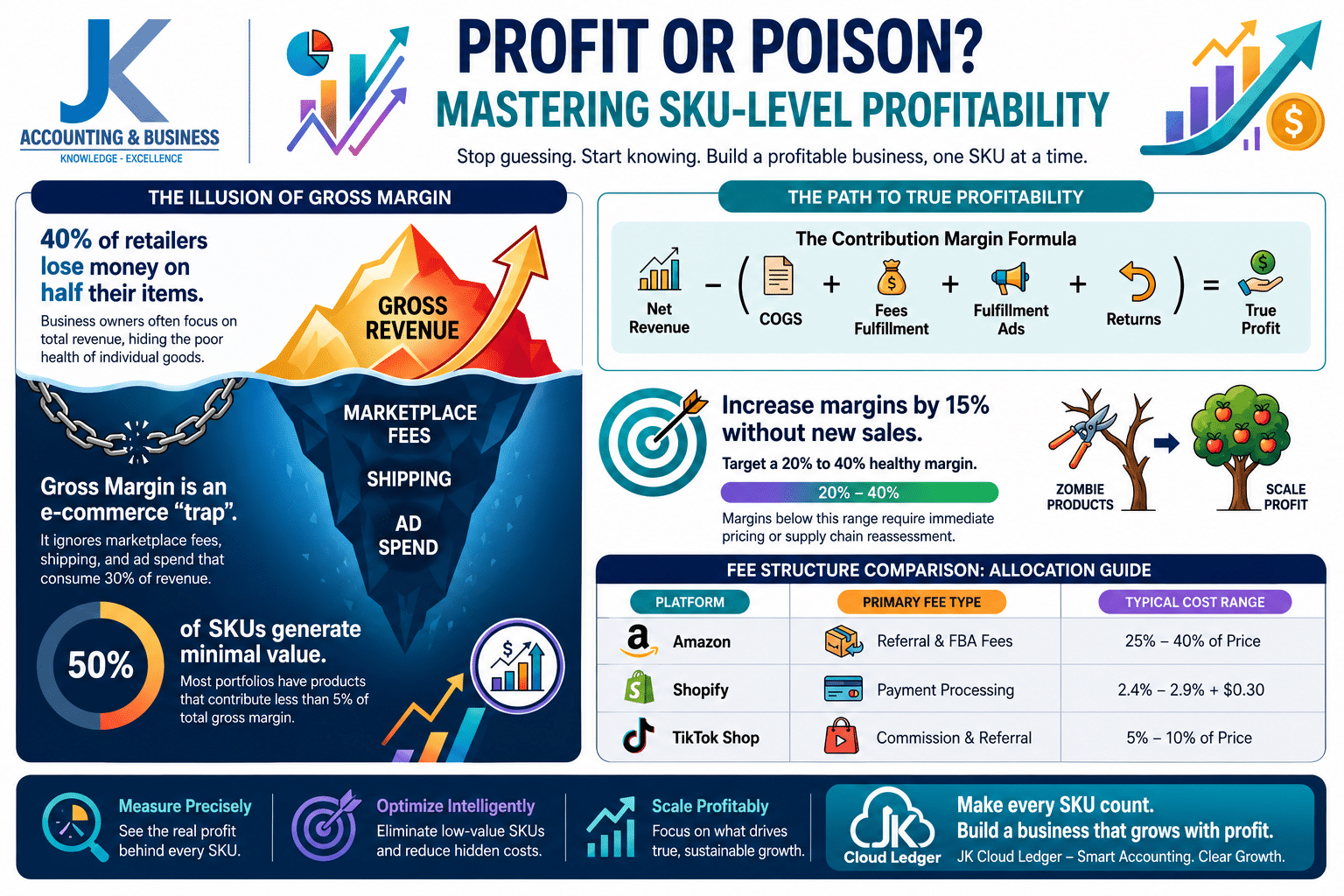
Marketplace fees, advertising costs, shipping expenses, and returns can significantly reduce product profitability despite healthy revenue figures.
“Vanity metrics like gross margin can make a failing business look profitable on paper, while actual cash flow quietly disappears through hidden operational expenses and marketplace fees.”
Beyond COGS: Identifying Variable Expenses
To accurately measure profitability, businesses must move beyond basic cost-of-goods-sold calculations. True product profitability emerges only after all variable expenses have been deducted from net revenue.
These costs often include payment processing fees, return shipping expenses, customer service costs, promotional discounts, marketplace commissions, and advertising spend required to generate each sale.
By tracking these expenses at the SKU level, businesses gain deeper visibility into which products support sustainable growth and which products create hidden financial strain.
| Metric | Gross Margin | Contribution Margin |
|---|---|---|
| COGS Included | Yes | Yes |
| Marketplace Fees | No | Yes |
| Variable Shipping Costs | No | Yes |
| Advertising Spend | No | Yes |
| Return & Refund Costs | No | Yes |
By adopting a more detailed e-commerce profitability framework, business owners can make better pricing decisions, optimize inventory investments, reduce unnecessary costs, and build a catalog where every product contributes meaningfully to the bottom line.
Mastering SKU Profitability Analysis and Contribution Margin
Understanding your unit economics is essential for sustainable e-commerce growth. Many sellers focus solely on revenue, neglecting the importance of SKU profitability analysis. This oversight can lead to financial instability and poor decision-making. By analyzing the profitability of each individual product, businesses gain deeper insight into what truly drives growth and protects cash flow.
Revenue alone does not determine business success. A product may generate impressive sales volume while contributing very little to actual profitability. Understanding product-level profit allows sellers to make informed inventory, pricing, and advertising decisions that strengthen long-term financial performance.
Developing a profitability-first mindset helps businesses identify hidden opportunities for growth while avoiding costly mistakes. Sellers who regularly evaluate product performance are better positioned to improve cash flow, optimize inventory investments, and maximize long-term returns.
The Contribution Margin Formula Explained
The cornerstone of any successful contribution margin e-commerce strategy lies in a simple yet powerful calculation. Contribution margin measures the amount of revenue remaining after all variable costs directly associated with a product sale have been deducted.
This remaining amount represents the profit available to cover fixed business expenses and generate net income. Unlike gross margin, contribution margin provides a more accurate picture of product-level profitability because it incorporates costs that directly impact each transaction.
The fundamental formula is:
Revenue − Variable Costs = Contribution Margin
Applying this formula across your product catalog creates a transparent view of product performance. It helps distinguish genuinely profitable products from those that generate revenue while consuming valuable business resources.
Businesses that understand contribution margin can make smarter pricing decisions, allocate advertising budgets more effectively, and focus on products that generate sustainable profitability.
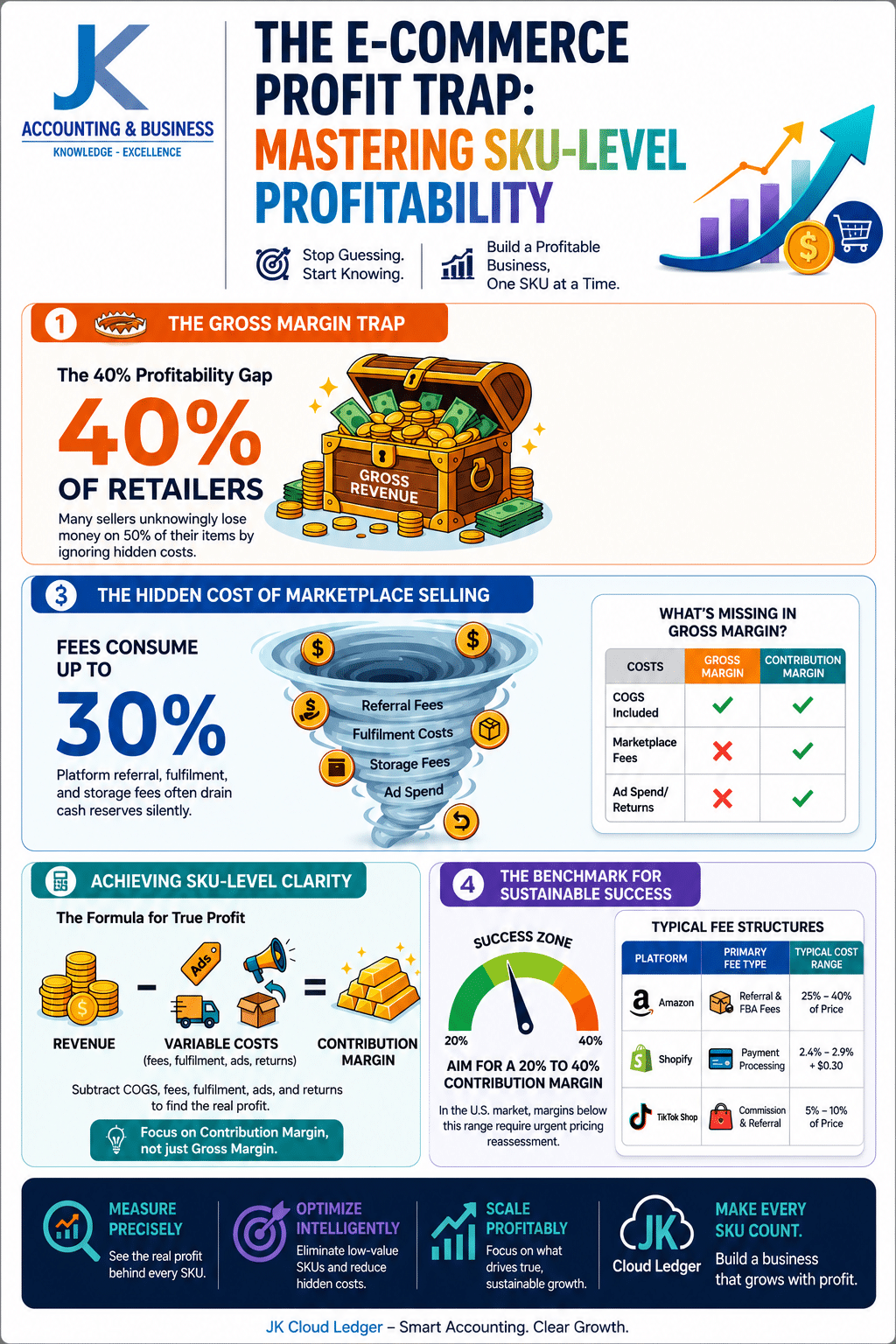
Contribution margin analysis helps ecommerce businesses identify which products generate sustainable profits after accounting for all variable costs.
Tracking Variable Costs: From Referral Fees to Returns
To accurately measure product-level profitability, every dollar spent to generate a sale must be accounted for. Many sellers underestimate the cumulative impact of recurring fees, which can significantly reduce actual margins.
A comprehensive e-commerce margin analysis should include all variable costs associated with selling a product, including:
Key Variable Costs to Monitor
- Cost of Goods Sold (COGS): The direct cost of inventory.
- Marketplace Fees: Referral fees, transaction fees, and closing costs.
- Fulfillment Costs: FBA fees, pick-and-pack charges, and shipping supplies.
- Advertising Spend: PPC and promotional costs directly attributed to the SKU.
- Return Costs: The hidden impact of customer returns and refunds.
Even small operational costs can have a significant impact when multiplied across hundreds or thousands of transactions. This is why successful sellers continuously monitor variable expenses and adjust their strategies accordingly.
For businesses selling through marketplaces such as Amazon, TikTok Shop, and independent ecommerce stores, tracking these expenses accurately is essential for maintaining healthy profit margins.
The Hidden Impact of Returns on Profitability
Understanding returns is particularly important when evaluating profitability. Many businesses underestimate the financial impact of returned products, which can quietly erode margins over time.
A practical way to estimate return-related expenses is:
(Return Rate %) × (Nonrefundable Fees + Product Write-Downs + Return Shipping Costs)
Including these costs in your profitability calculations helps prevent inflated margin estimates and supports more accurate financial forecasting.
The true cost of a return often extends beyond shipping expenses. Lost inventory value, restocking costs, customer service time, and marketplace penalties can all impact profitability.
| Cost Category | Included in Gross Margin | Included in Contribution Margin |
|---|---|---|
| Cost of Goods Sold (COGS) | Yes | Yes |
| Marketplace Fees | No | Yes |
| Advertising Costs | No | Yes |
| Shipping Expenses | No | Yes |
| Return Costs | No | Yes |
| Payment Processing Fees | No | Yes |
Within the U.S. e-commerce market, a healthy contribution margin generally ranges between 20% and 40%, although benchmarks vary depending on product category, competition, and fulfillment models.
Businesses operating below this range should evaluate pricing strategies, supplier relationships, operational efficiency, and advertising performance. Regular SKU profitability analysis enables businesses to remain competitive, improve cash flow management, and build a stronger foundation for sustainable growth.
For a deeper understanding of financial visibility and ecommerce profitability, explore our guide on why bookkeeping matters for ecommerce businesses .
Platform-Specific Fee Structures: Amazon, Shopify, and TikTok Shop
Many ecommerce sellers underestimate the impact of platform-specific fees on their overall profitability. While revenue may appear healthy across multiple sales channels, each platform applies its own fee structure that can significantly affect net margins at the SKU level.
Understanding these costs is essential when conducting a comprehensive SKU profitability analysis. Products that perform well on one platform may generate substantially lower profits on another due to differences in referral fees, fulfillment expenses, payment processing charges, and commission structures.
For multi-channel sellers operating across Amazon, Shopify, and TikTok Shop, comparing platform-specific costs helps identify the most profitable channels and supports better inventory allocation decisions.
As businesses expand into multiple states and marketplaces, it is equally important to understand tax obligations that may arise. For a deeper understanding of compliance requirements, read our guide on E-commerce Sales Tax Nexus: State-by-State Guide for Multi-Channel Sellers .
Navigating Amazon FBA Profitability and Referral Fees
Achieving consistent Amazon FBA profitability requires a detailed understanding of Amazon’s fee structure.
Beyond standard referral fees, which typically range between 8% and 15% depending on product category, sellers must also account for fulfillment fees, storage costs, inventory placement fees, and long-term storage charges.
These expenses vary based on product dimensions, weight, inventory turnover, and seasonal demand patterns. Without monitoring these costs closely, high-volume products can become surprisingly unprofitable.
Successful Amazon sellers regularly review contribution margins to ensure that increased sales volume translates into meaningful profitability rather than simply generating additional operational costs.
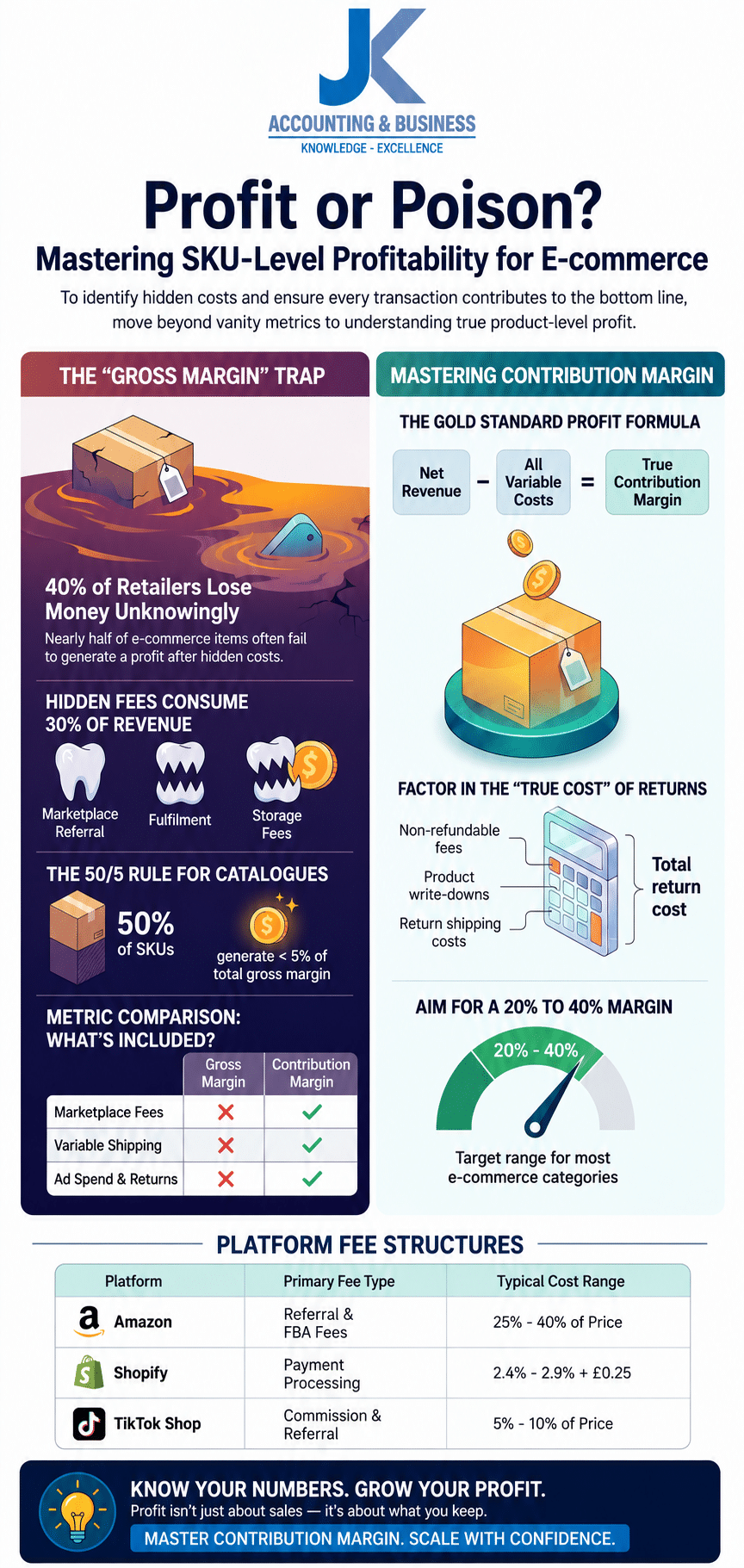
SKU-level profitability analysis reveals the hidden costs behind ecommerce sales and helps businesses improve contribution margins, optimize inventory decisions, and scale profitably across multiple marketplaces.
Managing Shopify Profit Per Product and Payment Processing
Operating an independent Shopify store often provides greater control over margins compared to marketplace platforms. However, sellers must still account for several recurring expenses that impact profitability.
Calculating Shopify profit per product involves evaluating subscription fees, payment processing costs, shipping expenses, app subscriptions, and customer acquisition costs.
Payment processing fees are particularly important because they apply to every transaction and can significantly influence contribution margins over time.
Businesses using multiple Shopify applications should also assess whether software expenses generate sufficient returns. While automation tools can improve efficiency, excessive app spending can quietly reduce profitability.
Understanding TikTok Shop Commission and Fulfillment Costs
TikTok Shop has rapidly emerged as a powerful ecommerce channel, but sellers must carefully evaluate commission structures and fulfillment costs when measuring profitability.
Platform commissions can vary depending on promotional campaigns, category incentives, and seller performance programs. These changing fee structures make ongoing profitability analysis particularly important.
In addition to referral fees, businesses should evaluate advertising spend, creator commissions, affiliate payouts, shipping expenses, and fulfillment costs when calculating product-level profitability.
Social commerce can generate substantial revenue growth, but maintaining healthy margins requires balancing customer acquisition costs against long-term profitability objectives.
| Platform | Primary Fee Type | Typical Cost Range | Fulfillment Model |
|---|---|---|---|
| Amazon | Referral Fees & FBA Costs | 25% – 40% of Sale Price | FBA or FBM |
| Shopify | Payment Processing | 2.4% – 2.9% + $0.30 | Merchant Managed |
| TikTok Shop | Commission & Referral Fees | 5% – 10% of Sale Price | Platform or Merchant Fulfillment |
The most profitable sales channel is not always the one generating the highest revenue. Platform-specific fees can dramatically impact SKU-level profitability.
Comparing platform-specific cost structures helps ecommerce businesses allocate inventory more effectively and prioritize channels that generate stronger contribution margins.
Businesses that regularly evaluate profitability across Amazon, Shopify, TikTok Shop, and other marketplaces gain a significant competitive advantage. Data-driven channel management allows sellers to maximize returns while maintaining healthy cash flow and sustainable growth.
Understanding platform economics at the SKU level ensures that growth initiatives are based on profitability rather than revenue alone, creating a stronger foundation for long-term ecommerce success.
Building Your Contribution Margin Dashboard
A robust contribution margin dashboard acts as the central nervous system of your ecommerce business. By centralizing financial and operational data, it provides the visibility needed to track SKU-level profitability across every sales channel. This level of insight helps businesses move beyond simple revenue metrics and focus on what truly drives long-term profitability.
Rather than relying on disconnected spreadsheets and manual calculations, modern ecommerce businesses use integrated reporting systems that deliver real-time visibility into sales performance, product margins, and operational costs. This enables faster decision-making and stronger financial control.
When properly implemented, a contribution margin dashboard becomes a powerful tool for identifying growth opportunities, reducing unnecessary expenses, and improving overall business performance.
Integrating Accounting Software and BI Tools
Modern ecommerce success depends on the seamless flow of information between sales platforms, accounting systems, and business intelligence tools. Automated integrations help synchronize sales revenue, marketplace fees, shipping expenses, and cost-of-goods-sold data in real time.
This automation significantly reduces manual data entry while minimizing the risk of human error. It also ensures that financial reports remain accurate and up to date as transaction volumes increase.
Whether evaluating Amazon FBA profitability, measuring Shopify profit per product, or analyzing TikTok Shop performance, automated reporting provides the foundation for reliable product-level profitability analysis.
By connecting accounting software with BI dashboards, businesses gain deeper visibility into trends, margin performance, and cash flow metrics that support more informed decision-making.
The Payout Reconciliation Gap: How to Fix Amazon, Shopify & TikTok Shop Deposits in QBO
One of the most common challenges facing ecommerce businesses is the payout reconciliation gap. This occurs when the net deposits received in a bank account differ from the gross sales amounts recorded in accounting software.
Marketplace platforms typically deduct fees, advertising costs, shipping charges, refunds, and other expenses before transferring funds to sellers. As a result, matching bank deposits to accounting records can become difficult without a structured reconciliation process.
A best practice is to establish dedicated clearing accounts for each marketplace. This allows businesses to track gross sales, pending fees, and settlement adjustments separately before deposits reach the primary operating account.
For a detailed walkthrough, read our guide: How to Fix Amazon, Shopify & TikTok Shop Deposits in QuickBooks Online .
Consistent reconciliation ensures that every dollar is properly accounted for and provides a clearer picture of actual cash flow and business performance.
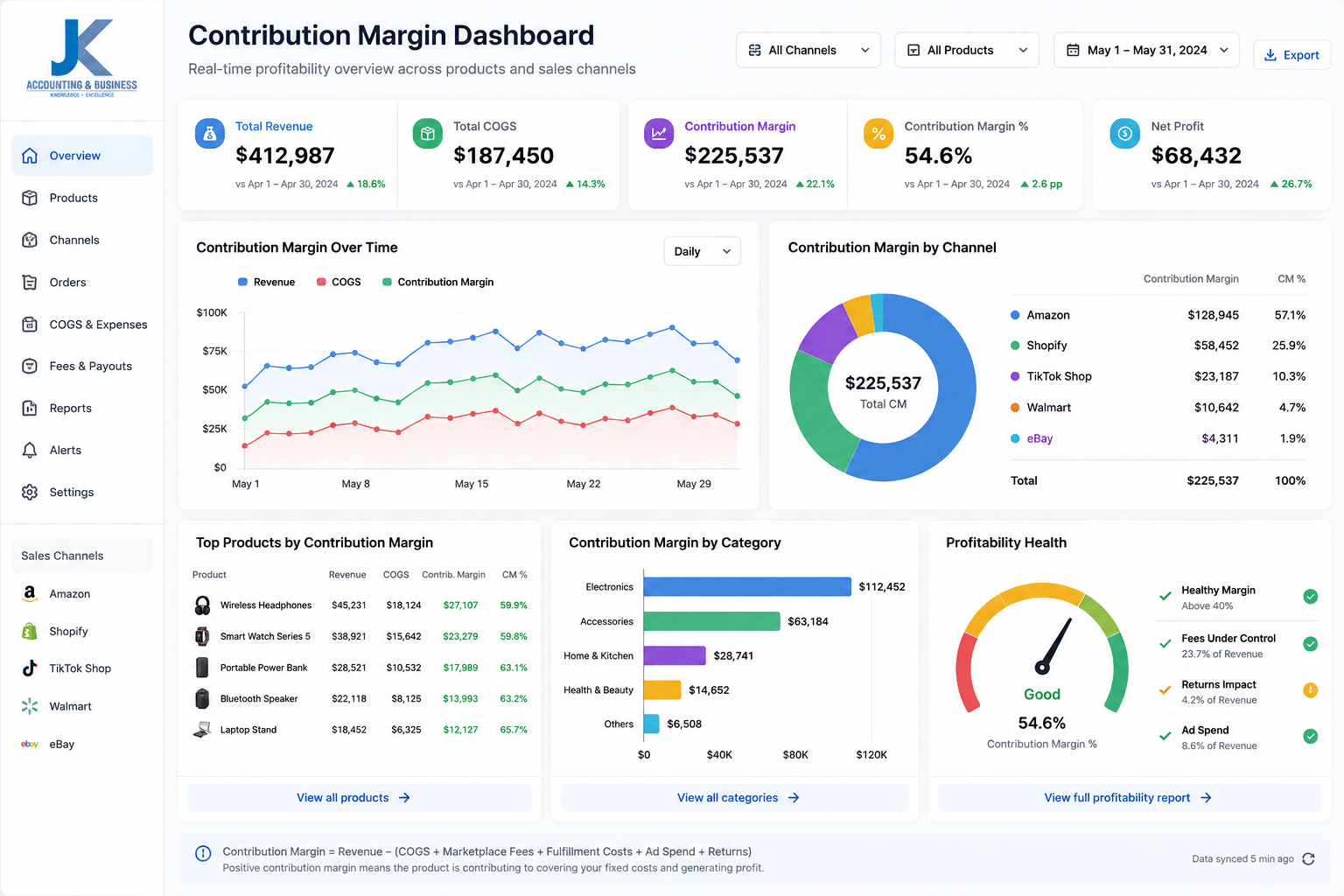
A contribution margin dashboard combines accounting data, marketplace performance metrics, and profitability reporting to provide real-time business insights.
Ensuring Data Accuracy for Real-Time Insights
Data accuracy is the foundation of effective financial decision-making. Even the most sophisticated dashboard can produce misleading insights if the underlying data is incomplete or inaccurate.
Businesses should regularly audit product costs, marketplace fees, shipping rates, and advertising expenses to ensure profitability calculations remain reliable. Changes in supplier pricing, fulfillment fees, or platform commissions can quickly impact contribution margins.
When financial data is accurate and updated consistently, businesses can confidently identify which products drive growth and which products reduce profitability. This visibility supports smarter inventory planning, pricing optimization, and resource allocation.
| Feature | Manual Spreadsheets | Automated BI Dashboard |
|---|---|---|
| Data Syncing | Manual / Delayed | Real-Time / Automated |
| Error Risk | High | Low |
| Scalability | Limited | High |
| Insight Depth | Basic | Advanced / Granular |
Businesses that automate profitability reporting gain faster insights, reduce reconciliation errors, and make more confident growth decisions.
As ecommerce businesses scale across multiple channels, maintaining accurate, real-time visibility becomes increasingly important. A well-designed contribution margin dashboard provides the financial clarity needed to optimize profitability, improve cash flow management, and support sustainable growth.
By combining accounting software, BI tools, and structured reconciliation processes, businesses can transform raw data into actionable insights that drive long-term success.
Strategic Applications of Product-Level Profit Tracking
Product-level profitability data empowers ecommerce businesses to move beyond assumptions and make decisions based on measurable financial performance. Rather than relying on intuition or sales volume alone, businesses can use profitability insights to optimize operations, improve cash flow, and maximize long-term growth.
When profitability data is integrated into daily decision-making, it becomes a powerful strategic tool. Business owners can identify opportunities for improvement, allocate resources more effectively, and focus their efforts on products that generate meaningful returns.
This proactive approach transforms financial reporting from a historical record into a growth-driving asset that supports sustainable business success.
Identifying Underperforming SKUs and Rationalizing Your Catalog
Not every product in your catalog deserves ongoing investment. Through detailed SKU profitability analysis, businesses can quickly identify products that consume time, inventory space, advertising budgets, and operational resources without generating acceptable returns.
In many ecommerce businesses, a relatively small percentage of products generate the majority of profits. Meanwhile, underperforming SKUs create unnecessary complexity while contributing little to overall profitability.
Catalog optimization requires making difficult but necessary decisions. Eliminating low-performing products allows businesses to simplify operations, improve inventory turnover, and focus resources on high-margin products that support sustainable growth.
By regularly reviewing SKU-level profitability reports, business owners can build a more efficient product portfolio that maximizes both profitability and operational efficiency.
“Profit is the applause you get for taking care of your customers and creating motivating environments for your people.”
— Ken Blanchard
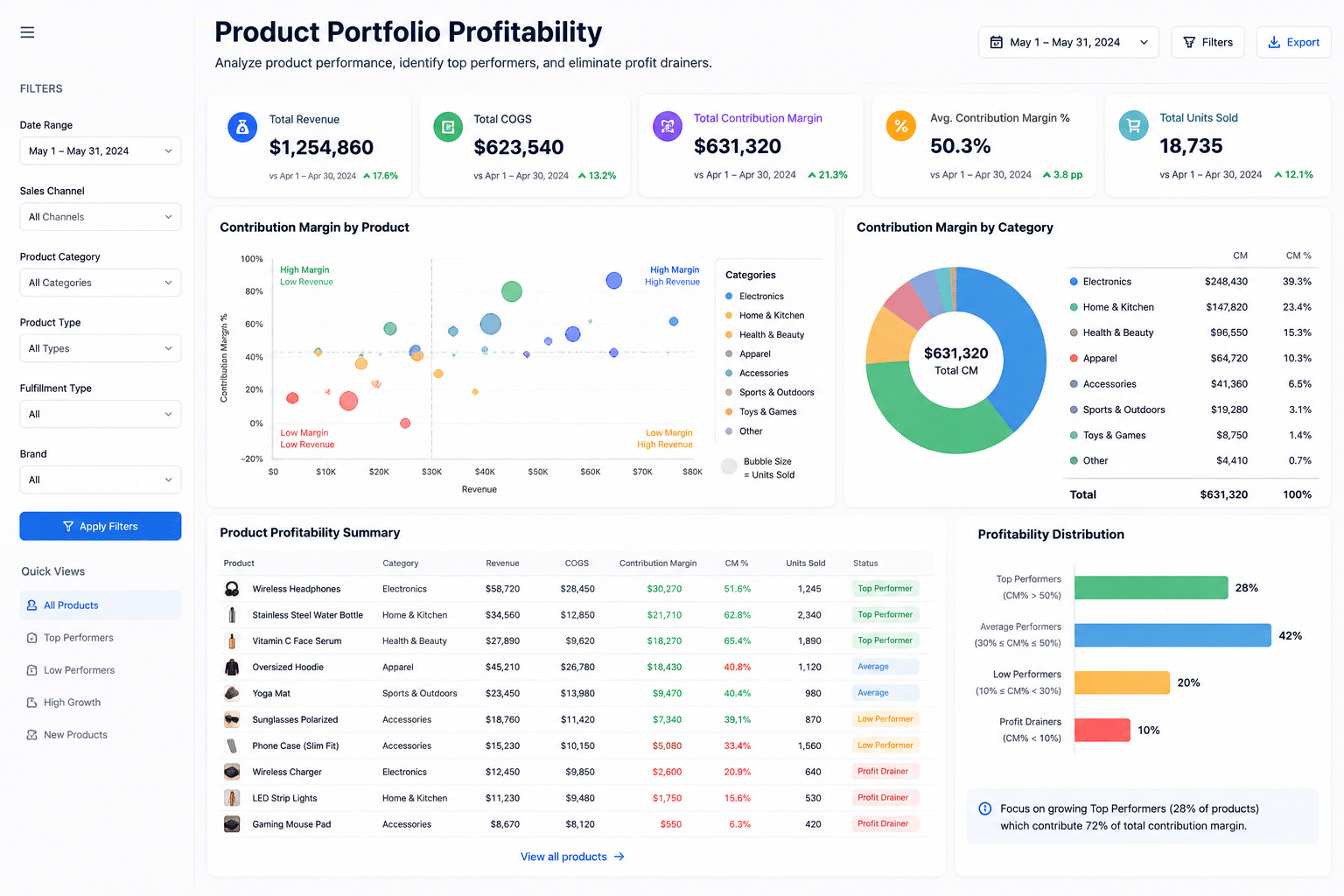
SKU-level profitability analysis helps businesses identify high-performing products while eliminating inventory that reduces overall profitability.
Pricing Strategy Based on Contribution Margin
Effective pricing decisions depend on a clear understanding of contribution margin. Businesses that accurately measure product-level profitability can make pricing adjustments with confidence rather than relying on assumptions.
Products with strong contribution margins may provide opportunities to lower prices strategically, increase market share, and drive additional sales volume without sacrificing profitability.
Conversely, products with thin margins may require price increases, supplier renegotiations, bundling strategies, or operational improvements to remain financially viable.
Contribution margin analysis allows businesses to evaluate the financial impact of discounts, promotions, and advertising campaigns before implementing changes. This ensures pricing decisions are aligned with overall profitability goals.
Data-driven pricing decisions help maximize total profit while maintaining competitive positioning in the marketplace.
Inventory Optimization Using Profitability Data
Inventory management becomes significantly more effective when profitability metrics are incorporated into purchasing decisions. Rather than stocking products based solely on historical sales trends, businesses can prioritize products that generate the strongest financial returns.
Investing capital in slow-moving or low-margin inventory can create unnecessary cash flow pressure. By combining inventory analytics with profitability data, businesses can identify which products deserve additional investment and which products should be phased out.
This approach supports healthier cash flow management by ensuring capital is allocated toward products that contribute positively to business growth.
Businesses that use profitability-driven inventory strategies often reduce storage costs, improve inventory turnover, and increase overall return on investment across their product catalog.
As ecommerce competition continues to intensify, maintaining lean inventory levels while prioritizing high-margin products can create a significant competitive advantage and improve long-term business sustainability.
| Business Decision | Without Profitability Data | With SKU Profitability Analysis |
|---|---|---|
| Product Selection | Based on Sales Volume | Based on Actual Profitability |
| Pricing Decisions | Assumption-Based | Margin-Driven |
| Inventory Purchasing | Revenue Focused | Profitability Focused |
| Marketing Allocation | Equal Distribution | Focused on High-Profit Products |
| Growth Strategy | Revenue Growth | Sustainable Profit Growth |
Case Study: How One Seller Increased Margins by 15 Percent
Many ecommerce sellers focus primarily on increasing revenue, believing that higher sales automatically lead to greater profitability. However, one online retailer discovered that sustainable growth depended not on generating more revenue but on understanding the profitability of every product within their catalog.
By moving beyond surface-level metrics and adopting a product-level profitability approach, the business transformed its financial performance. The turning point came through a detailed review of operational costs, contribution margins, and SKU-level performance data.
This case study demonstrates how a disciplined approach to profitability analysis can unlock significant financial improvements without requiring additional sales volume.
The Initial Audit: Uncovering Hidden Losses
The process began with a comprehensive review of the company’s inventory and financial records. Rather than focusing exclusively on sales performance, the business conducted a detailed ecommerce margin analysis to determine the true profitability of each product.
The findings revealed several hidden issues that had been negatively affecting overall business performance:
Key Audit Findings
- Several high-volume products generated minimal profits due to elevated return rates.
- Multiple SKUs became unprofitable after accounting for marketplace fees and shipping expenses.
- Advertising budgets were being allocated to products with weak conversion rates and low contribution margins.
- Inventory investments were concentrated in products that delivered limited financial returns.
This audit highlighted a common ecommerce challenge: strong revenue performance can often mask underlying profitability problems. Without SKU-level analysis, many of these issues would have remained hidden.
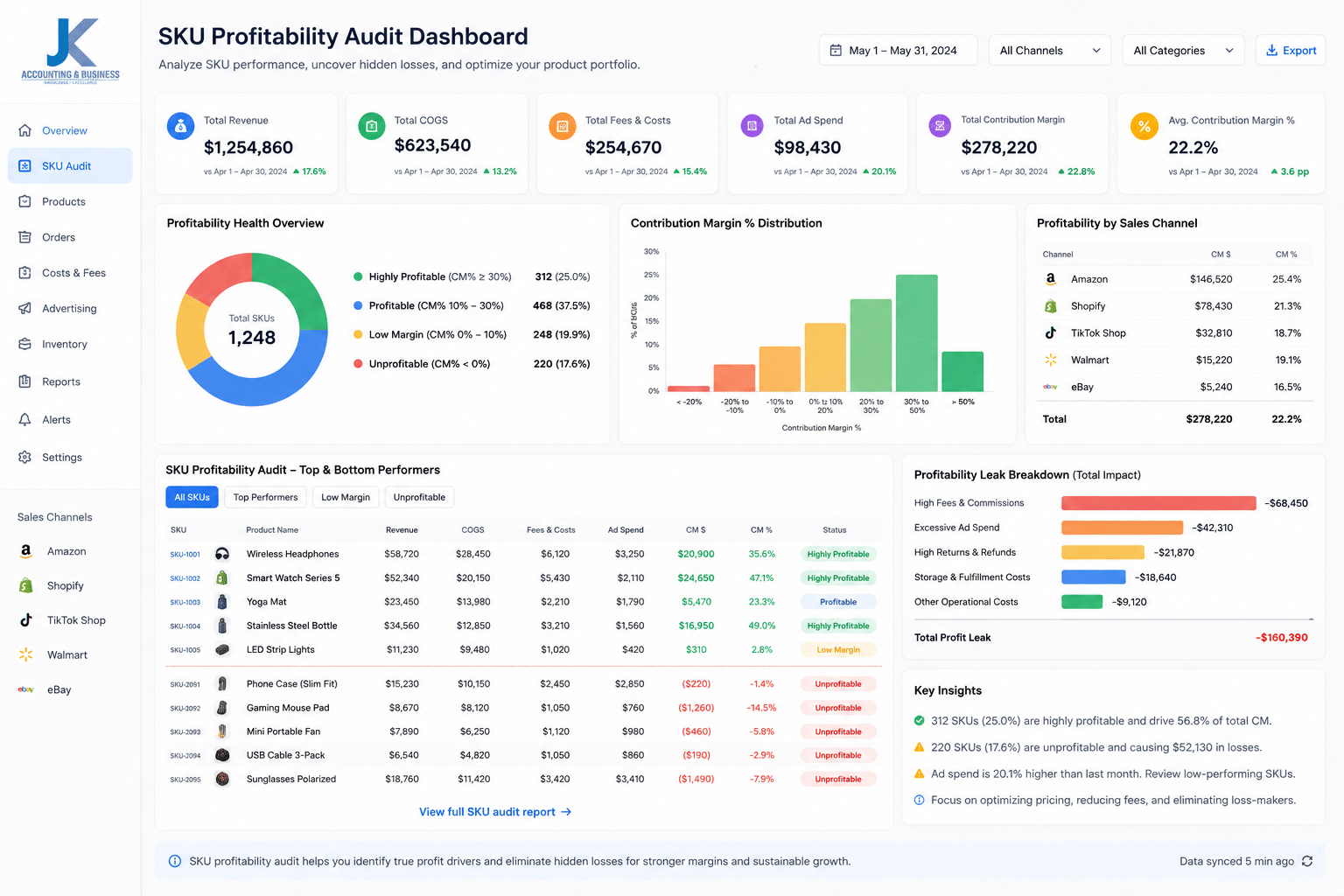
A detailed profitability audit helps ecommerce businesses identify hidden losses, optimize product portfolios, and improve overall financial performance.
Operational Changes and Strategic Pricing Adjustments
Armed with accurate profitability data, the business implemented several operational and pricing changes designed to improve margins and strengthen cash flow.
Rather than viewing the catalog as a single revenue-generating asset, management began treating each product as an independent profit center. This shift allowed them to make more targeted decisions based on actual financial performance.
Strategic Actions Implemented
- Discontinued or repriced products that failed to meet minimum contribution margin requirements.
- Bundled lower-margin products with high-margin complementary items to increase average order profitability.
- Optimized Amazon FBA operations by reducing unnecessary storage and fulfillment expenses.
- Improved Shopify product profitability through strategic pricing adjustments and promotional restructuring.
- Renegotiated shipping agreements to lower fulfillment costs across multiple product categories.
The Results: Scaling Profitability Over Revenue
The impact of these changes became evident within a relatively short period. Over the following six months, the business achieved a 15% increase in overall profit margins without significantly increasing total sales revenue.
This improvement was driven primarily by better product selection, improved pricing discipline, reduced operational waste, and more effective allocation of marketing resources.
Rather than pursuing aggressive revenue growth at all costs, the company focused on maximizing profitability from existing sales activity. This approach resulted in stronger cash flow, healthier margins, and improved financial stability.
| Metric | Before Optimization | After Optimization |
|---|---|---|
| Revenue Focus | Primary KPI | Secondary KPI |
| SKU Profitability Tracking | Limited | Comprehensive |
| Advertising Efficiency | Moderate | Improved |
| Contribution Margin Visibility | Low | High |
| Overall Profit Margin | Baseline | +15% |
The most profitable businesses do not necessarily generate the highest revenue—they generate the highest return from every dollar of revenue earned.
This case study illustrates the power of data-driven decision-making. By prioritizing profitability over vanity metrics, the seller built a more resilient and scalable business model capable of supporting long-term growth.
For ecommerce businesses operating in increasingly competitive markets, understanding where money is earned—and where it is lost—can be the difference between sustainable growth and ongoing financial challenges.
Ultimately, product-level profitability analysis provides the clarity needed to make smarter business decisions, improve financial performance, and create a stronger foundation for future expansion.